Managing F-Gas Records: Systems, Cylinders and Log Entries
Effective F-Gas record-keeping is essential for compliance — how to manage systems, cylinders, and log entries to meet EU F-Gas Regulation requirements.
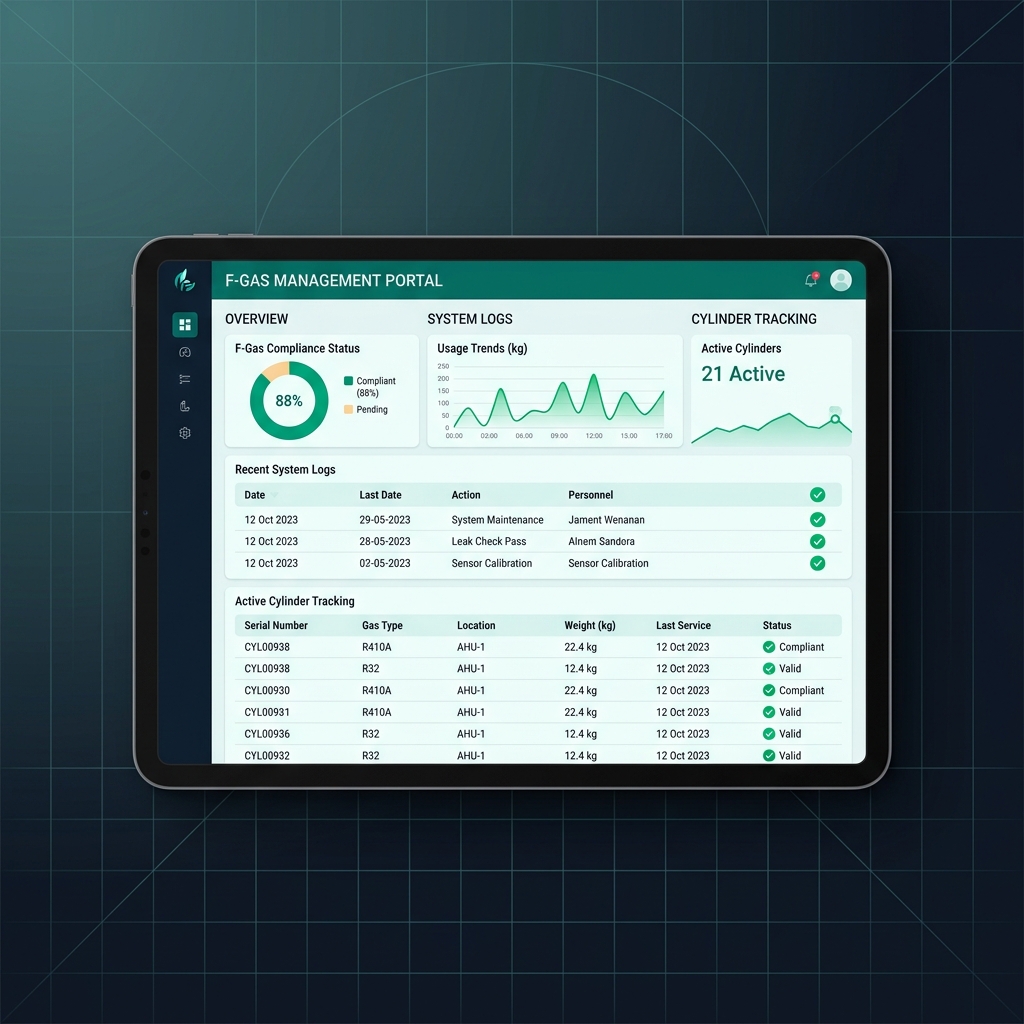
Keeping accurate F-Gas records is not optional — it is a legal requirement under current F-Gas rules and a core competency tested in City & Guilds 2079. Whether you are managing a single split system or overseeing dozens of commercial installations, understanding how to properly log refrigerant charges, track cylinders, and document leak tests is fundamental to compliance.
This article walks through the practical side of F-Gas record management — creating systems, setting up cylinders, recording log entries, and handling consignment notes — drawing on a detailed walkthrough of a digital F-Gas management workflow.
Why F-Gas Record-Keeping Matters
Under current F-Gas rules, operators of equipment containing fluorinated greenhouse gases must establish and maintain records for each in-scope piece of equipment. These records must include:
- The quantity and type of fluorinated greenhouse gas in the system
- Quantities added during installation, maintenance, or servicing
- Quantities recovered during servicing, maintenance, or final disposal
- Identification of the certified engineer and certified company
- Dates and results of leak checks
- Details of any decommissioning measures taken
In the EU, those records must be kept for at least five years and made available to the relevant authority upon request. For anyone sitting the City & Guilds 2079 exam, this falls squarely within the Skill Group 1 (Regulations) domain — expect questions on what must be recorded, by whom, and for how long.
Setting Up an F-Gas System Record
The foundation of good F-Gas management is creating a proper system record. Each refrigeration or air conditioning system needs its own entry, capturing:
- Company and site — which customer and location the system belongs to
- System description and reference — a clear identifier for the equipment
- Plant location — where exactly on site the system is installed
- Refrigerant type — selected from the list of regulated gases, each with its associated Global Warming Potential (GWP)
- Design charge — the manufacturer’s specified refrigerant quantity
- Initial charge — the actual quantity charged at commissioning
“The next thing I want to do is put the design charge of this particular system. I also want to put the initial charge as well.”
Getting these values right from the start is critical. The design charge and GWP together determine the system’s CO2 equivalent (CO2e), which in turn dictates the leak check frequency required under the regulation. This is a calculation you will absolutely need to understand for the exam — converting a refrigerant charge in kilograms to tonnes of CO2e by multiplying the charge by the GWP and dividing by 1,000.
Commissioning Dates and Leak Test Schedules
Once a system record is created, the next step is recording the installation and commissioning dates. These dates are not merely administrative — they drive the automatic calculation of when the next leak test is due.
The leak test schedule is determined by the CO2e of the system:
| CO2 Equivalent | Leak Check Frequency | With Leak Detection System |
|---|---|---|
| 5–50 tonnes CO2e | Every 12 months | Every 24 months |
| 50–500 tonnes CO2e | Every 6 months | Every 12 months |
| Over 500 tonnes CO2e | Every 3 months | Every 6 months |
Setting up leak test reminders — for example, 30 days before the next check is due — ensures nothing falls through the cracks. This is exactly the kind of proactive compliance management that the regulation encourages and the exam tests your understanding of.
Recording Log Entries
Every time refrigerant is added to or removed from a system, a log entry must be created. This includes:
- Additions — topping up after a leak repair or during servicing
- Removals — recovering gas into a cylinder before maintenance or decommissioning
- Leak tests — recording the date, method, and result
- Corrections — adjusting records if errors are identified
- Leak records — documenting any detected leaks
“In order to keep systems in a valid state, FGAS logs need to be added in a chronological order.”
This point deserves emphasis. Logging entries out of sequence creates discrepancies in the calculated charge, making it impossible to accurately track how much refrigerant is in the system at any given time. For exam purposes, understand that accurate, chronological record-keeping is best practice because the law requires accurate, up-to-date records.
When removing gas, you must specify which cylinder the refrigerant is being transferred into. This creates a complete audit trail — you can trace exactly where every kilogram of refrigerant has gone, from the system to the cylinder to its final destination.
Managing Cylinders
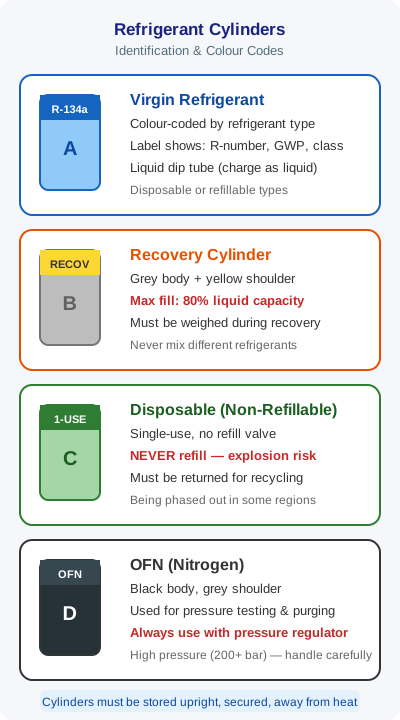
Cylinders require their own set of records, separate from but linked to the systems they serve. Each cylinder record should capture:
- Description and serial number
- Refrigerant type
- Tare weight (the empty weight of the cylinder)
- Initial charge and capacity
- Supplier details
- Location — whether on a van, at a site, or in storage
If cylinders are rented, the rental period should be recorded with start and end dates, along with reminders before the rental agreement expires.
Cylinder operations that must be logged include:
- Refills — when new refrigerant is added from a supplier
- Transfers — when gas is moved between cylinders
- Recovery — when gas is taken from a system into a cylinder
Each of these creates a log entry against the cylinder, building up a complete history of its contents over time. This level of traceability is precisely what the regulation demands and what inspectors will look for during audits.
Consignment Notes for Waste Refrigerant
When waste refrigerant needs to be disposed of or sent for reclamation, a consignment note must be completed. This is a legal document under hazardous waste regulations that records:
- The source — which company and site the waste originated from
- The destination — typically a specialist waste handler or reclamation facility
- The waste producer — the company responsible for generating the waste
- Cylinder details — which cylinders are included in the consignment
Consignment notes create a paper trail proving that waste refrigerant has been handled responsibly and in accordance with both F-Gas rules and broader environmental waste legislation. Recovered gases must be passed into the correct reclamation, recycling, or disposal route rather than vented or abandoned.
Linking Equipment to Systems
A single F-Gas system may comprise multiple pieces of equipment — for example, several indoor air conditioning units connected to a shared outdoor condensing unit. Linking individual equipment items to their parent system ensures that all components are covered by the same leak testing schedule and that any work carried out on a component is recorded against the correct system.
This is particularly relevant for VRF/VRV systems and multi-split installations, where the total refrigerant charge across all connected units determines the CO2e and therefore the regulatory requirements.
How F-Gas Exam Prep Fits Into This
Understanding F-Gas record-keeping is not just about passing an exam — it is about being a competent, compliant refrigeration professional. But when it comes to the City & Guilds 2079 assessment, you will face questions on exactly these topics: what must be recorded, who is responsible, how long records must be kept, and how leak test frequencies are determined.
The F-Gas Exam Prep app gives you the tools to master these requirements:
- 460+ exam questions covering all skill groups, including dedicated sections on regulations, record-keeping, and leak testing procedures
- Mock exams that mirror the real City & Guilds 2079 format, so you know exactly what to expect on test day
- AI voice challenges for interactive revision — perfect for reinforcing your understanding of regulatory requirements while you are on the move
- Detailed explanations for every answer, helping you understand not just the correct response but the reasoning behind it
Whether you are preparing for your initial certification or brushing up before a reassessment, solid knowledge of F-Gas record-keeping requirements will serve you well — both in the exam room and out on site.
Start Practising Today
Download the F-Gas Exam Prep app and study with 460+ practice questions, mock exams, and detailed explanations.