F-Gas Process and Equipment Walk-Through: Essential Tools for Heat Pump Work
A practical guide to the key pieces of equipment used in F-Gas refrigerant handling, from recovery machines and vacuum pumps to leak detectors and brazing sets.

Whether you are preparing for your City & Guilds 2079 assessment or gearing up for your first heat pump installation, understanding the tools and equipment used in F-Gas work is fundamental. Knowing what each piece of kit does — and why it matters — is not just exam knowledge; it is the foundation of safe, compliant refrigerant handling.
This guide walks through the main pieces of equipment you will encounter when working on heat pumps and refrigerant circuits, covering their purpose and the processes they support.
Contents:
Recovery Machines and Refrigerant Weighing
Before any work can begin on a refrigerant circuit — whether you are replacing a plate heat exchanger, a condenser, or any other component — the refrigerant must be removed safely and in a controlled manner. This is where the recovery machine comes in.
The recovery machine pulls the refrigerant out from the heat pump and transfers it into a cylinder where it would be safely stored until it is ready to be reintroduced back into the heat pump.
Under current F-Gas rules, refrigerant must never be deliberately vented to atmosphere. Recovery is a legal requirement, and using properly rated recovery equipment is the compliant way to extract refrigerant from a circuit. The recovered gas is stored in a dedicated recovery cylinder until it can be recharged back into the system, reclaimed, or disposed of through an approved waste route.
Alongside the recovery machine, a set of scales is used to weigh the refrigerant cylinder. This allows you to measure precisely how much refrigerant has been removed from — or introduced into — the circuit. Accurate measurement is essential for maintaining the correct system charge and for completing the legally required records in the F-Gas log.
Vacuum Pumps and Torr Gauges
Once the refrigerant has been recovered and any repair or installation work completed, the circuit must be evacuated before recharging. A vacuum pump removes air, moisture, and other non-condensable gases or vapours from the system.
Without a vacuum pump these particles can cause inefficient operation and potential corrosion of internal components.
Moisture is particularly damaging in a refrigerant circuit. It can form acids when it reacts with refrigerant and compressor oil, leading to copper plating, bearing wear, and eventual compressor failure. A thorough evacuation is not optional — it is a critical step in every installation and major service.
To confirm the vacuum is deep enough, a Torr gauge (also known as a micron gauge) is used alongside the vacuum pump. This instrument measures absolute pressure in microns and provides readings on the dehumidification status of the system — essentially confirming that moisture and non-condensable gases have been pulled down to an acceptable level. Torr gauges are available in both digital and analogue versions, and a digital model with data logging can be particularly useful for documenting your work.
Manifold Gauges and Hoses
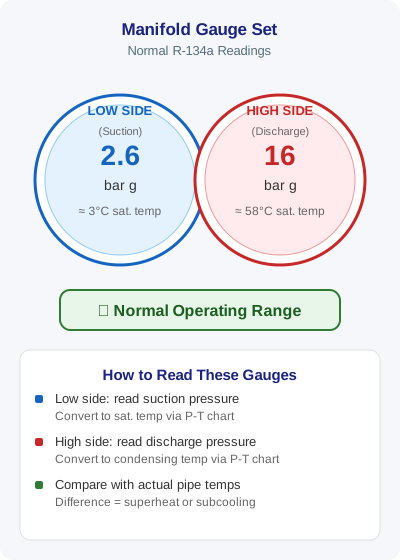
A manifold gauge set is one of the most frequently used pieces of equipment in refrigerant work. It connects to the high and low pressure sides of the system and allows you to:
- Check system pressures during operation
- Diagnose whether the system is correctly charged
- Add refrigerant to the circuit
- Detect potential refrigerant leaks through abnormal pressure readings
Both analogue and digital versions are available. Digital manifold gauges often include built-in pressure-temperature charts for common refrigerants such as R-410A and R-32, which can speed up diagnostics considerably.
To connect your equipment to the heat pump system, you need refrigerant-rated hoses with appropriate fittings. These hoses must be rated for the correct pressure and compatible with the type of refrigerant you are working with. Various fittings are available, including angled adaptors and quick-release connectors that make the job faster and reduce the risk of refrigerant loss during connection and disconnection.
Electronic Leak Detectors
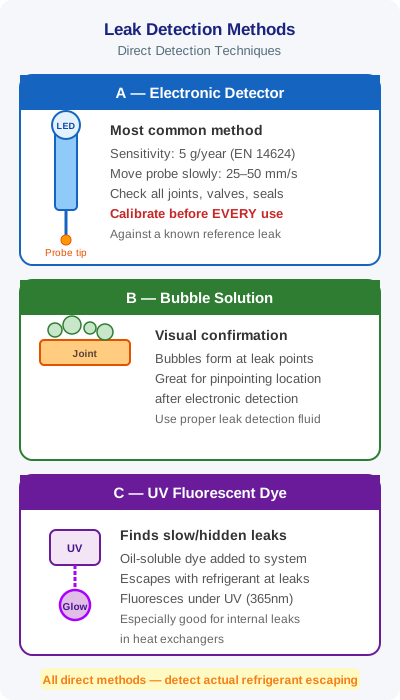
Refrigerant leaks are a significant environmental and regulatory concern. Under the F-Gas Regulation, operators of equipment containing fluorinated greenhouse gases are required to carry out regular leak checks, and any detected leaks must be repaired promptly.
Electronic leak detectors are used to identify the location of any refrigerant leak. They are sensitive enough to detect very small concentrations of refrigerant in the air and are essential for:
- Checking joints and connections after any work on the refrigerant circuit
- Tracing leaks on existing systems during service visits
- Verifying hoses and connections before and during work processes
A good-quality leak detector calibrated for the refrigerant type you are working with is an indispensable part of your toolkit. This links directly to Skill Group 2 (Leak Checks) in the City & Guilds 2079 syllabus, which covers leak detection methods, mandatory leak check intervals, and record-keeping requirements.
Temperature Probes and Monitoring
Various types of temperature probes and clamps are available for refrigerant work, from single probes to dual pipe clamps. Many modern gauges can connect to smartphone apps, enabling you to take single readings or monitor temperatures over a period of time.
Taking temperatures at different points of the refrigerant circuits can help identify refrigerant issues when used in conjunction with pressure and temperature charts specific to the type of refrigerant being used.
By comparing measured temperatures and pressures against the saturation charts for a given refrigerant, you can calculate superheat and subcooling values — two of the most important diagnostic indicators for system performance. Abnormal values can point to issues such as undercharge, overcharge, restricted flow, or a faulty expansion device.
Many heating engineers will already own temperature probes for measuring flow and return temperatures on heating circuits. The same instruments can often be repurposed for basic heat pump diagnostics, though dedicated refrigerant clamp probes tend to offer better accuracy and faster response times on copper pipework.
Nitrogen: Pressure Testing and Brazing
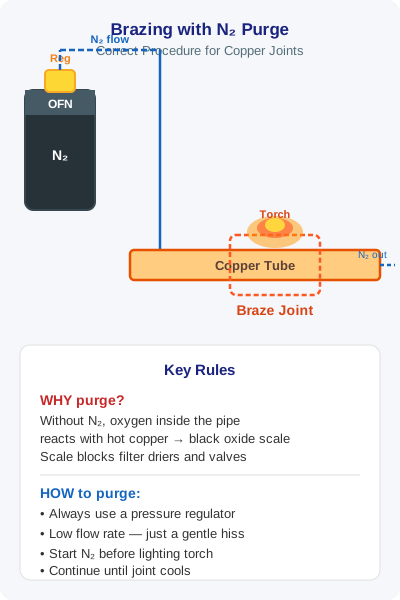
Oxygen-free nitrogen (OFN) plays two important roles in refrigerant work:
-
Pressure testing — Nitrogen is used to pressurise refrigerant lines and components before any refrigerant is added. Because it is inert, non-reactive, non-flammable, and stable across a wide range of temperatures, it is ideally suited for strength and tightness testing. It is also readily available and low cost.
-
Purging during brazing — When brazing copper refrigerant joints, dry nitrogen is flowed through the tube to displace oxygen and prevent oxidation. Without this step, black copper oxide scale forms inside the pipe, which can flake off and block expansion devices, damage compressor valves, or contaminate the system oil.
Pressure testing with nitrogen is a mandatory step covered under Skill Group 5 (Tightness and Strength Testing) in the City & Guilds 2079 assessment. You should be familiar with the correct test pressures, hold times, and the procedures for both strength and standing pressure decay tests.
Pipework and Brazing Tools
When installing refrigerant lines for split heat pumps or air conditioning systems, specialised tools are required. The copper pipe used for refrigerant lines is fundamentally different from standard plumbing copper — it features a thicker wall design with a much higher pressure rating.
The jointing techniques are also different. Key tools include:
- Oxy-acetylene brazing set — for making high-strength brazed joints on copper refrigerant pipework, typically using silver-bearing brazing alloys
- Flaring tool — for creating flared connections, commonly used on split system installations where mechanical joints are preferred
- Swaging tool — for expanding the end of one pipe to accept another of the same diameter, enabling a socket joint without additional fittings
These tools are primarily associated with installation and component replacement rather than routine diagnostics. For most day-to-day maintenance tasks, temperature probes, manifold gauges, and leak detectors will be your go-to equipment.
How F-Gas Exam Prep Fits Into This
Understanding equipment and processes is woven throughout the City & Guilds 2079 syllabus — from Skill Group 1 (Basic Thermodynamics) through to Skill Group 11 (Practical Competence). The exam tests not just whether you can name a piece of equipment, but whether you understand why it is used and when it is required.
The F-Gas Exam Prep app is designed to help you build and test that understanding:
- 460+ exam-style questions covering all skill groups, including dedicated questions on equipment use, recovery procedures, vacuum standards, leak detection, and pressure testing
- Mock exams that mirror the real City & Guilds 2079 format, so you can practise under timed conditions
- AI voice challenges for interactive revision — a different way to test your recall when you are tired of reading
- Detailed explanations for every answer, helping you understand the reasoning behind each correct response, not just memorise facts
Whether you are revising recovery procedures, brushing up on leak check regulations, or getting to grips with superheat and subcooling calculations, the app covers it all. Download it today on iOS or Android and start preparing with confidence.
Start Practising Today
Download the F-Gas Exam Prep app and study with 460+ practice questions, mock exams, and detailed explanations.