The Refrigeration Cycle Explained: A Foundation for F-Gas Certification
A clear walkthrough of the basic vapour-compression refrigeration cycle, mapped to the knowledge you need for City & Guilds 2079 and day-to-day F-Gas work.
Understanding the basic refrigeration cycle is the single most important foundation for anyone preparing for the City & Guilds 2079 assessment. Whether you are a new technician taking your first F-Gas qualification or an experienced engineer brushing up before reassessment, the vapour-compression cycle underpins every fault-finding decision you will make on site. Let’s walk through it the way you should be able to explain it on exam day.
The Two Sides of Every System
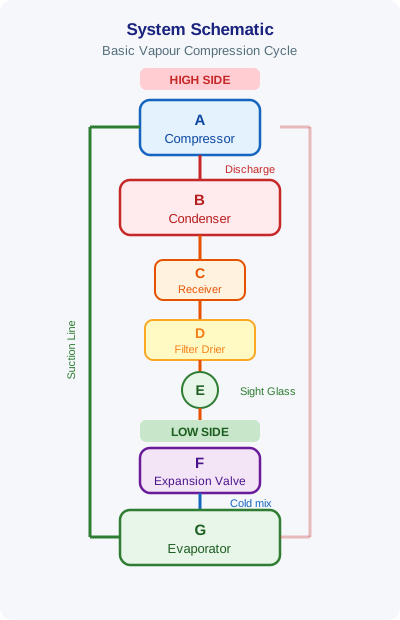
Every direct-expansion refrigeration or air conditioning system is divided into two distinct sides:
- High-pressure, high-temperature side (typically shown in red on schematics)
- Low-pressure, low-temperature side (typically shown in blue)
Two components — and only two — separate these sides:
- The compressor — increases refrigerant pressure, which in turn raises its temperature
- The metering device — reduces refrigerant pressure, which in turn lowers its temperature
“The compressor’s job is to increase the pressure of the refrigerant in order to increase the temperature. The metering device’s job is to lower the refrigerant pressure in order to lower the temperature of the refrigerant.”
This simple division is the framework on which all your pressure-temperature diagnostics rest, and it is foundational knowledge for the F-Gas theory paper.
Following the Refrigerant Around the Loop
Let’s trace the refrigerant through a complete cycle, starting at the compressor inlet.
1. Compressor — Where the Cycle Begins
Low-pressure, low-temperature vapour refrigerant enters the compressor (often a reciprocating compressor in smaller systems). The compressor squeezes that vapour, raising its pressure dramatically. As pressure rises, so does temperature. What exits the compressor is high-pressure, high-temperature discharge vapour.
Remember: the compressor is hermetically sealed. The electric motor windings inside are exposed to the refrigerant, which means the refrigerant doesn’t just carry heat around the system — it also cools the motor. Anything that contaminates the refrigerant (moisture, acid, debris) puts those windings at risk.
2. Condenser — Rejecting Heat to Outside
Hot discharge gas enters the condenser coil. Outdoor air is blown across the coil, pulling heat out of the refrigerant. As the refrigerant rejects heat, it condenses from vapour to liquid. By the time it leaves the condenser, you should have high-pressure, high-temperature sub-cooled liquid — fully in the liquid state with a temperature slightly below its saturation temperature.
Sub-cooling is a critical concept for the F-Gas assessment. A well-charged system with a thermostatic expansion valve typically targets a specific sub-cooling value at the condenser outlet, and measuring it is one of the standard charge-checking methods.
3. Liquid Line — Filter Drier and Service Valves
The sub-cooled liquid travels through:
- The liquid line service valve — a connection point for pressure readings or isolation
- The filter drier — absorbs water vapour and traps debris
“The filter drier’s job is to absorb any water vapour in the system… so that the water vapour in the system does not mix with the refrigerant oil which could damage the compressor electrical windings.”
Filter driers have a finite moisture-holding capacity. After any system opening, brazing, or component replacement, the filter drier should be changed and the system properly evacuated — these are core competencies under City & Guilds 2079 skill group 6 (commissioning and decommissioning) and skill group 9 (leak checks and pump-down procedures).
4. Metering Device — The Pressure Drop
The sub-cooled liquid is forced through a small orifice — in this case a piston metering device, though TXVs and electronic expansion valves are also common. Pressure drops suddenly, and with it the saturation temperature. Some of the liquid immediately flashes off into vapour because the surrounding liquid is now hotter than its new boiling point.
What enters the evaporator is roughly 80% liquid and 20% flash gas — a saturated mixture. This is exactly what we want.
5. Evaporator — Absorbing Heat from the Conditioned Space
Inside the evaporator, the magic of phase change does the work. Because the refrigerant is saturated, liquid and vapour coexist, and any heat absorbed is used as latent heat of vaporisation:
- The refrigerant boils at a constant low temperature
- Indoor air blown across the coil gives up its heat to the boiling refrigerant
- By the end of the coil, all the liquid has boiled off
- The vapour then superheats slightly above its saturation temperature
The refrigerant leaves the evaporator as low-pressure, low-temperature vapour — ready to re-enter the compressor and start the cycle again.
Why Saturated Refrigerant Must Never Reach the Compressor
This is one of the most heavily tested concepts in F-Gas theory and one of the most common real-world causes of compressor failure.
“That compressor is a vapour compressor. You shouldn’t have saturated refrigerant entering into that compressor — saturated means there’s going to be a little bit of liquid in the refrigerant. That would damage the compressor.”
Liquid is incompressible. If liquid reaches the compressor cylinders, you risk:
- Slugging — broken valves, reeds, or connecting rods
- Oil dilution — refrigerant mixes with crankcase oil, washing out lubrication
- Bearing failure — once oil loses its film strength
A failed indoor fan motor or blocked filter is a classic trigger: the refrigerant cannot absorb heat at the evaporator, so it never boils off completely, and saturated refrigerant slugs the compressor on the suction line.
Mapping the Cycle to F-Gas Duties
While F-Gas law focuses on environmental obligations rather than thermodynamics, your competence to handle refrigerants safely still depends on understanding what is happening inside the system. Key links include:
- Article 4 (leak checks) — frequency depends on CO₂-equivalent charge, which requires you to know where in the cycle refrigerant sits and how to access it via service valves
- Article 8 (recovery) — you must recover refrigerant in both liquid and vapour phases, which means understanding saturated conditions
- Annex I — lists the F-gases and their GWPs; a competent engineer needs to relate these to charge sizes in real systems
How F-Gas Exam Prep Fits Into This
The basic refrigeration cycle is foundational across every City & Guilds 2079 skill group, from system installation and leak checking through to recovery, charging, and decommissioning. If you cannot trace refrigerant around the loop and explain phase changes confidently, the rest of the syllabus will feel disconnected.
The F-Gas Exam Prep app is built to make that foundation solid:
- 460+ exam-style questions across all 11 City & Guilds 2079 skill groups (plus Health & Safety), with cycle diagrams, sub-cooling and superheat scenarios, and component-fault questions
- Mock exams that mirror the real C&G 2079 format and time limits, so nothing on assessment day surprises you
- AI voice challenges — talk through cycle theory hands-free while you’re driving between jobs or on a break
- Detailed explanations for every answer, so when you get a flash-gas or sub-cooling question wrong, you understand exactly why
Master the cycle, and the rest of your F-Gas preparation falls into place. Practise it until you can sketch and explain it without thinking — that’s the level of fluency the assessor is looking for.
Start Practising Today
Download the F-Gas Exam Prep app and study with 460+ practice questions, mock exams, and detailed explanations.