EU F-Gas Regulation 517/2014 in Context: Why It Still Matters
The original EU Regulation 517/2014 phase-down and leak-test changes explained — and why it still appears in legacy F-Gas training since 2024/573 replaced it.

As of June 2026, Regulation 517/2014 has already been repealed in the EU by Regulation 2024/573. It still matters, though, because many training videos, older slide decks, legacy specifications, and even some UK discussions still refer back to the 2014 regime. This post explains that original framework in its historical context.
A Quick Historical Recap of Regulation 517/2014
Regulation (EU) 517/2014 was adopted in April 2014 and entered into force at the beginning of June that year. The practical effect was felt from 1 January 2015, when it replaced the previous EC Regulation 842/2006. It remained the EU framework until 2024/573 replaced it.
Three elements sit at the heart of the regulation:
- A 79% phase-down in the total quantity of HFCs placed on the EU market, delivered gradually between 2015 and 2030.
- A shift from refrigerant mass to CO2 equivalence as the unit that drives leak checks and reporting.
- Specific application bans tied to the global warming potential (GWP) of the refrigerant and the type of equipment.
“The previous legislation on F gas has changed… from this point of view I would like to bring your attention on the following: seventy-nine percent reduction of F gas gradual phase-down from 2015 until 2030.”
The Phase-Down in Numbers
The phase-down is the mechanism that squeezes high-GWP refrigerants out of the market. Taking the average quantity of HFCs placed on the EU market between 2009 and 2012 as the 100% reference baseline, the regulation cuts the allowance in six discrete steps:
- 2015: baseline established at 100%
- 2016 to 2017: reduced to 93%
- 2018 to 2020: reduced to 63%
- 2021 to 2023: reduced to 45%
- 2024 to 2026: reduced to 31%
- 2027 to 2029: reduced to 24%
- From 2030: reduced to 21%
That final 21% figure is the one to remember when reading older training material. By the end of the original phasedown, only around one fifth of the original quota would be available.
From Kilograms to Tonnes of CO2 Equivalent
One of the most practical changes for engineers on the ground is how leak tests are scheduled. Under Regulation 842/2006 the test intervals were defined by the mass of refrigerant in kilograms. Under 517/2014 the trigger is the tonnes of CO2 equivalent of the total charge, calculated as:
Refrigerant mass (kg) × GWP ÷ 1,000 = tonnes CO2 equivalent
Regular leak checks are prescribed for any system containing 5 tonnes of CO2 equivalent or more, with the frequency increasing for larger charges and halving where a permanent leak detection system is fitted. In practice, a system charged with a high-GWP refrigerant such as R404A (GWP 3,922) will cross the 5 tonne threshold with only about 1.3 kg of charge. A system on R32 (GWP 675) can hold much more before the same obligation kicks in.
This single change tilts the economics firmly towards lower-GWP and natural refrigerants.
Application Bans by Segment
Alongside the phase-down, the regulation imposes outright bans on placing specific products on the market once a GWP threshold is exceeded. The most relevant milestones for commercial refrigeration include:
- Domestic refrigerators and freezers: refrigerants with GWP ≥ 150 banned from 1 January 2015.
- Hermetically sealed commercial refrigerators and freezers: GWP ≥ 2,500 banned from 2020, GWP ≥ 150 banned from 2022.
- Centralised multipack commercial systems ≥ 40 kW: refrigerants with GWP ≥ 150 restricted, with cascade primary circuits allowed up to GWP 1,500.
- Stationary refrigeration equipment generally: GWP ≥ 2,500 banned from 2020 (with limited service exemptions).
Lining up the GWPs makes the picture obvious. R32 sits at around 675, R410A at 2,088, R404A at 3,922 and R507A at 3,985. The higher the GWP, the earlier the door closes.
Why CO2 and R290 Are the Winning Refrigerants
If you strip away the chemistry and look only at the regulation, two natural refrigerants come out ahead for commercial refrigeration.
- CO2 (R744) has a GWP of 1 and no application ban to worry about. It is becoming the default choice for refrigerated cabinets with a remote condensing unit, supermarket packs and industrial applications.
- R290 (propane) has a GWP of 3 and is the natural fit for plug-in refrigerated cabinets with a built-in condensing unit.
“CO2 will be, in our point of view, the only refrigerant allowed for refrigerated cabinets with a remote condensing unit, and for plug-in applications R290 will be the gas.”
The direction of travel was clear even under the 2014 regime: lower-GWP and natural refrigerants became more attractive as quota pressure increased and application bans tightened.
Technical Implications for Heat Exchangers
Working with natural refrigerants changes what a heat exchanger has to do:
- CO2 design pressures sit between 45 and 60 bar, which demands thicker tube walls or, better, smaller-diameter tubes with optimised geometry.
- Low-charge hydrocarbon designs push manufacturers to minimise internal volume while preserving capacity.
- Smaller-diameter tubes and tighter, more efficient coil layouts are common responses when designers need to keep charge down without sacrificing performance.
The cleverer designs do not simply thicken existing tubes to survive higher pressures — they exploit the thermodynamic strengths of CO2 and R290 to deliver higher efficiency in a smaller footprint.
What This Means for Your City & Guilds 2079 Assessment
Regulation 517/2014 runs through several skill groups of the 2079 syllabus:
- Environmental impact of refrigerants — understanding GWP, ODP and the phase-down schedule.
- F-Gas Regulation knowledge — the specific articles covering leak checks, record keeping, labelling and producer responsibilities.
- Containment and leakage — calculating CO2 equivalent, choosing leak check intervals and using permanent leak detection.
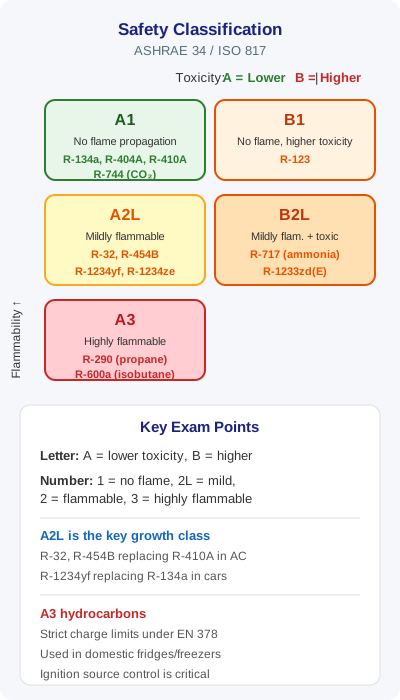
- Health and safety — working with flammable (A3) refrigerants like R290 and high-pressure systems like CO2.
Expect questions that give you a mass and a GWP and ask whether a leak check is due, or that test whether a particular product could still be placed on the market after a given date.
How F-Gas Exam Prep Fits Into This
The F-Gas Exam Prep app is built around this kind of regulation-heavy material. You get 460+ exam questions spread across every City & Guilds 2079 skill group, including dedicated sets on Regulation 517/2014, CO2 equivalence calculations and application bans. Full mock exams mirror the real 2079 format so there are no surprises on assessment day, and AI voice challenges let you revise key terms and scenarios hands-free on the drive to a job. Every answer comes with a detailed explanation, so if you pick the wrong GWP threshold or the wrong leak test interval, you will understand exactly why before you see the question again.
Start Practising Today
Download the F-Gas Exam Prep app and study with 460+ practice questions, mock exams, and detailed explanations.