Refrigeration Cycle 101: The Four Components Every F-Gas Technician Must Know
How the vapour-compression cycle moves heat through the compressor, condenser, metering device and evaporator, for the City & Guilds 2079 F-Gas assessment.

Ask ten instructors to explain the refrigeration cycle and you’ll get ten different starting points. But strip away the jargon and every system you’ll ever touch — a domestic split, a supermarket pack, a chiller, a heat pump — runs on the same four components doing the same four jobs. If you can picture those jobs clearly, you’ve got the backbone you need for your City & Guilds 2079 F-Gas assessment and for diagnosing real plant in the field.
This is genuinely 101 material, but it’s the foundation everything else sits on. Let’s walk through it the practical way.
The Four Components — And What They Actually Do
Memorise these in order, because the refrigerant flows through them in this sequence, round and round:
- Compressor — the pressure increaser
- Condenser — the heat rejector
- Metering device — the pressure dropper
- Evaporator — the heat absorber
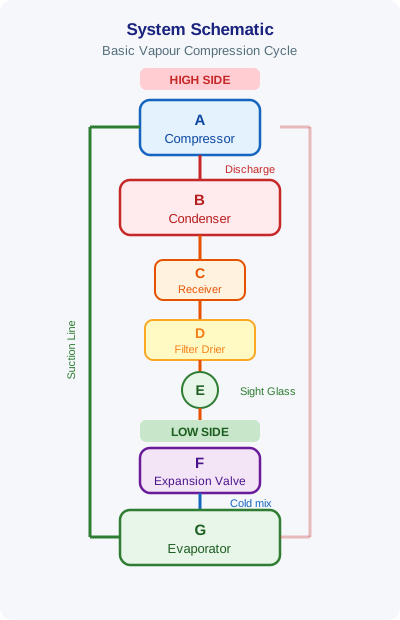
“We’re absorbing heat, we’re pressurising it, increasing the pressure, we’re removing the heat, we’re dropping the pressure, then absorbing heat — pressurising, round and round and round.”
If you forget every component name under exam pressure, fall back on the plain-language version: pressure increaser, heat rejector, pressure dropper, heat absorber. That’s the whole cycle in four phrases.
The One Law Worth Remembering: PV = nRT
You don’t need to be a physicist to be a good engineer, but the ideal gas law underpins everything here. Written out it’s PV = nRT, which separates neatly into two halves:
- Pressure and volume on one side
- Mass and temperature (plus a gas constant) on the other
The key takeaway isn’t the algebra — it’s the relationship. Change any one of these and you change the others. Mass tends to stay fairly constant as the refrigerant circulates, but we’re constantly manipulating pressure, volume and temperature.
That gives us the two rules the whole cycle exploits:
- Increase the pressure → increase the temperature
- Decrease the pressure → decrease the temperature
“When we compress something we’re causing it to occupy a smaller space, which increases the pressure… when we decrease the pressure we’re allowing it to occupy a larger space, which then can decrease the temperature.”
What a Refrigerant Really Is
A refrigerant sounds exotic, but at heart it’s “just something we’re continuously pressurising and depressurising” in order to manipulate temperature — so we can get heat into the fluid and then back out of it. That’s the entire goal.
The earliest systems used air and water, then moved through CO₂ and various toxic gases, and today we use comparatively safe fluids — although the industry is circling back to flammable and toxic options like propane (R290) and ammonia (R717) for their environmental performance.
This matters for F-Gas. The whole reason your certification exists is that the synthetic HFCs that replaced those early gases are potent greenhouse gases. Modern F-Gas rules govern their containment, recovery and phase-down precisely because of their high Global Warming Potential. Understanding that refrigerant is simply a heat-transfer medium being squeezed and released helps you appreciate why leak checks, recovery and proper handling — the core of your Health & Safety and Containment skill groups — are non-negotiable.
Exam tip: The regulation drives a real distinction between flammability and toxicity classes (A1, A2L, A3, B1, etc.). Knowing that newer low-GWP refrigerants are often mildly flammable (A2L) or toxic explains the additional handling and leak-detection requirements you’ll be tested on.
Following the Refrigerant Round the Circuit
The Compressor — Pressure Increaser
The compressor draws low-pressure vapour in through the suction line — a line that’s actually cool to the touch in an air-conditioning application. It only ever pumps vapour. By forcing that refrigerant into a smaller volume, it raises the pressure significantly, and with it the temperature.
Scroll, rotary, reciprocating — the type varies, but the outcome is identical: vapour goes in at lower pressure and temperature, and leaves at high pressure and high temperature. In doing so it also lowers the pressure on the suction side and circulates the fluid through the whole system.
The Condenser — Heat Rejector
That hot, high-pressure discharge gas travels down the discharge line into the condenser. Here the refrigerant rejects the heat we “revealed” by pressurising it — either to air (an air-cooled condenser with aluminium fins, like the outdoor unit on a domestic split) or to water (plate or tube-in-tube heat exchangers in commercial, water-source and geothermal systems).
As it rejects heat, the refrigerant condenses from vapour to liquid.
“Regardless of the liquid-to-vapour, boiling, condensing — all of that — a condenser is going to reject heat.”
Interestingly, state change isn’t strictly necessary to move heat — the earliest machines just pressurised and depressurised without boiling anything. But leveraging the phase change between liquid and vapour “greatly increases the amount of heat you can move,” which is why modern systems lean on it so heavily.
The Metering Device — Pressure Dropper
The fully condensed liquid now travels down the liquid line to the metering device. Common types you’ll meet:
- Thermostatic expansion valve (TXV) — modulates flow based on superheat
- Capillary tube — in window units, PTACs and domestic fridges
- Piston / fixed orifice — a piece of brass with a precise hole, common on older or lower-efficiency systems
- Electronic expansion valve (EEV / EXV) — like a TXV but electronically modulated
Whatever the type, the job is the same: drop the pressure. And when you drop the pressure, you drop the saturation temperature. Some of the liquid also immediately boils off — known as flash gas — because the refrigerant has been throttled to a much lower pressure. The expansion device is not “adding cold”; it is creating the low-pressure conditions that let the evaporator absorb heat.
The Evaporator — Heat Absorber
That now cold, low-pressure mixture enters the evaporator. As air from the conditioned space passes over the coil, the cold refrigerant absorbs heat from it — the indoor coil of your home system in cooling mode is doing exactly this. The refrigerant fully boils to a vapour and heads back down the suction line to the compressor, and the cycle begins again.
“More than anything else, I want you to get that picture in your head — it’s absorbing heat from the inside of the space.”
Heat Versus Temperature
One subtle point worth nailing for the exam: heat and temperature are not the same thing. Temperature is average molecular velocity — how fast the molecules are moving on average. By changing the volume the refrigerant can occupy, we change that average velocity, and therefore the temperature. Compress it into a smaller space and the molecules speed up (hotter); let it expand and they slow down (cooler). Heat is then free to flow from hot to cold — which is all a refrigeration system is engineering.
The Three Lines to Memorise
Newer technicians should commit two short lists to memory early on. First the components — compressor, condenser, metering device, evaporator — and then the three principal lines:
- Discharge line — between the compressor and condenser (hot, high-pressure vapour)
- Liquid line — between the condenser and metering device (high-pressure liquid)
- Suction line — from the evaporator back to the compressor (cool, low-pressure vapour)
You may also see an “expansion line” between the metering device and evaporator in some diagrams, but it isn’t universal — on ductless systems the metering device often lives outside, so it’s frequently absent. The three above are the ones you must be able to identify and distinguish.
How F-Gas Exam Prep Fits Into This
The basic circuit is the lens you’ll view every F-Gas topic through — pressures and temperatures, leak detection, recovery, charging and component faults all make sense once the four-component model is second nature. That’s exactly the kind of fundamentals the F-Gas Exam Prep app is built to drill.
- 460+ exam questions spread across every City & Guilds 2079 skill group, including Refrigeration Fundamentals, Containment and Health & Safety
- Mock exams that mirror the real City & Guilds 2079 format, so the structure and timing feel familiar on assessment day
- AI voice challenges for hands-free, interactive revision — perfect for testing whether you can name the four components and their jobs out loud
- Detailed explanations for every answer, so when you get a pressure/temperature question wrong you learn why, not just the correct option
Get the circuit clear in your head — pressure increaser, heat rejector, pressure dropper, heat absorber — then let the question bank turn that understanding into exam-ready recall. Master the fundamentals here and the rest of your F-Gas preparation has somewhere solid to stand.
Start Practising Today
Download the F-Gas Exam Prep app and study with 460+ practice questions, mock exams, and detailed explanations.