The Vapour Compression Refrigeration Cycle Explained for F-Gas Candidates
A component-by-component walk through the vapour-compression refrigeration cycle, and why F-Gas technicians must understand it for the City & Guilds 2079 exam.

Ask any experienced refrigeration engineer where you should start when learning the trade, and almost all of them will point you back to the same place: the vapour compression cycle. Whether you are commissioning a 1 tonne split system or fault-finding on a large chiller, the same four-stage process is running underneath. Get comfortable with it and the rest of the F-Gas syllabus starts to fall into place.
This guide breaks the cycle down component by component, in the order the refrigerant actually travels, and then connects it to what the City & Guilds 2079 assessment expects you to know.
The Job of the Cycle: Moving Heat, Not Making Cold
The single most important idea to fix in your mind is this:
According to the law of thermodynamics, we do not cool any substance. We only remove the heat from that substance. As heat is removed the object is cooled.
That is why this process is also called the heat pump cycle. We are not adding “cold” to a room — there is no such thing. We are picking up unwanted heat from one place, carrying it somewhere else, and dumping it. The medium that does the carrying is the refrigerant, and the whole machine exists to make that refrigerant absorb heat where we want cooling and reject it where we do not.
Keep that framing in mind throughout, because it explains why each component does what it does.
The Four Core Components
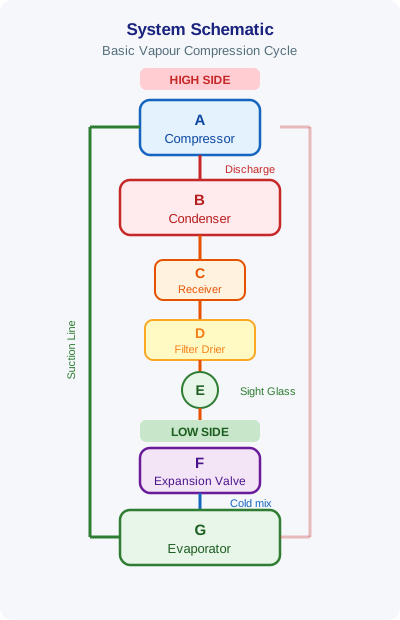
Every vapour compression system, large or small, is built around four components:
- Compressor
- Condenser
- Expansion valve
- Evaporator
Let us follow a packet of refrigerant all the way round.
1. The Compressor — the Pump of the System
The compressor is the heart of the cycle. Its purpose is to raise the pressure of the refrigerant so it can be pushed all the way around the circuit.
- Refrigerant enters the compressor as a low-pressure, low-temperature vapour.
- The compressor squeezes that vapour hard.
- Refrigerant leaves as a high-pressure, high-temperature vapour.
With the help of the compressor the refrigerant travels through the cycle.
Note that compression raises both pressure and temperature. This is why the discharge line is the hottest part of the system — useful to remember when you are diagnosing a fault by touch or with a thermometer.
2. The Condenser — Rejecting Heat
After the compressor, the hot, high-pressure vapour flows into the condenser coil, which is a heat exchanger.
The condenser cools the refrigerant arriving from the compressor. As that heat is given up to the surrounding air (or water, in a water-cooled system), the refrigerant changes state from vapour to liquid — this is condensation.
- Refrigerant enters as high-pressure, high-temperature vapour.
- Refrigerant leaves as high-pressure, lower-temperature liquid.
This is the point in the cycle where the heat collected indoors is finally thrown away outdoors.
3. The Expansion Valve — Dropping the Pressure
Next comes the expansion device. There are several types:
- Thermostatic expansion valves (TXV/TEV) — the most common in field equipment.
- Electronic expansion valves (EEV) — the most advanced, giving finer control.
- Capillary tubes and fixed orifices on simpler systems.
Whatever the type, the job is the same: take the high-pressure liquid coming from the condenser and reduce its pressure. When the pressure drops, the temperature drops with it.
Whatever the expansion valve is, its important job is to reduce the pressure of the refrigerant. By reducing the pressure, the temperature of the refrigerant will decrease.
Refrigerant leaves the expansion valve as a low-pressure, low-temperature liquid-vapour mixture, now cold enough to absorb heat from the space we want to cool.
4. The Evaporator — Absorbing Heat
Finally, the cold liquid enters the evaporator, the second heat exchanger in the circuit. A fan draws warm room air across the evaporator fins.
- The warm air gives up its heat to the cold refrigerant.
- The refrigerant boils off, changing from liquid back to vapour.
- The air leaving the coil is now well cooled — this is the cold air you feel from the supply grille.
The refrigerant, now a low-pressure, low-temperature vapour again, returns to the compressor and the whole cycle begins once more.
Tying the States Together
A neat way to revise the cycle is to track the two things that change at each stage — pressure and state:
| Stage | Pressure | Temperature | State |
|---|---|---|---|
| Compressor outlet | High | High | Vapour |
| Condenser outlet | High | Low(er) | Liquid |
| Expansion valve outlet | Low | Low | Liquid |
| Evaporator outlet | Low | Low | Vapour |
Exam tip: Heat is rejected at the condenser and absorbed at the evaporator. The condenser and evaporator are both heat exchangers — the difference is simply the direction heat is flowing.
Why This Matters for F-Gas Compliance
Understanding the cycle is not just theory — it underpins almost everything current F-Gas rules ask of you in practice.
- Leak checking (Article 4). Operators of equipment must carry out leak checks at intervals set by the system’s charge expressed in CO₂ equivalent (the thresholds in Annex IV-style terms — 5, 50 and 500 tonnes CO₂e). To find a leak with electronic detectors or to interpret gauge pressures, you must know what pressure and temperature the refrigerant should be at each point in the cycle.
- Prevention of emissions (Article 3). Knowing where high-pressure vapour sits (compressor discharge, condenser) tells you where the system is most likely to emit refrigerant if a joint or seal fails.
- Recovery (Article 8). Safe recovery depends on understanding the liquid and vapour phases — you recover liquid from the high side and vapour from the low side, exactly the states described above.
- Charging. Subcooling at the condenser and superheat at the evaporator are measured against the cycle states; you cannot charge a system correctly without that mental model.
For City & Guilds 2079, the vapour compression cycle sits squarely in the refrigeration fundamentals and basic thermodynamics skill groups, and it threads through the practical assessment categories on leak detection, recovery and good environmental practice. Examiners frequently ask candidates to label the four components, state the pressure/temperature/phase at each point, and explain which component rejects heat and which absorbs it.
How F-Gas Exam Prep Fits Into This
The vapour compression cycle is the foundation everything else is built on — so it is exactly the sort of topic where structured practice pays off. The F-Gas Exam Prep app is designed to take you from “I understand the diagram” to “I can answer any question the examiner throws at me”:
- 460+ exam questions spread across every City & Guilds 2079 skill group, including dedicated sets on refrigeration fundamentals, leak checking, and recovery.
- Mock exams that mirror the real City & Guilds 2079 format, so the timing and question style feel familiar before you walk into the test centre.
- AI voice challenges that let you revise the cycle interactively — describe what happens at the condenser out loud and get instant feedback.
- Detailed explanations for every answer, so when you get a pressure/temperature/phase question wrong, you understand why rather than just memorising the right option.
Master the four components and the states between them, drill the questions until they are second nature, and you will find the rest of the F-Gas syllabus far easier to navigate. The cycle really is the key that unlocks the whole qualification.
Start Practising Today
Download the F-Gas Exam Prep app and study with 460+ practice questions, mock exams, and detailed explanations.