The Basic Refrigerant Circuit: How Refrigeration and Air Conditioning Really Work
A plain-English walk through the four core components of the vapour-compression cycle: compressor, condenser, metering device and evaporator.
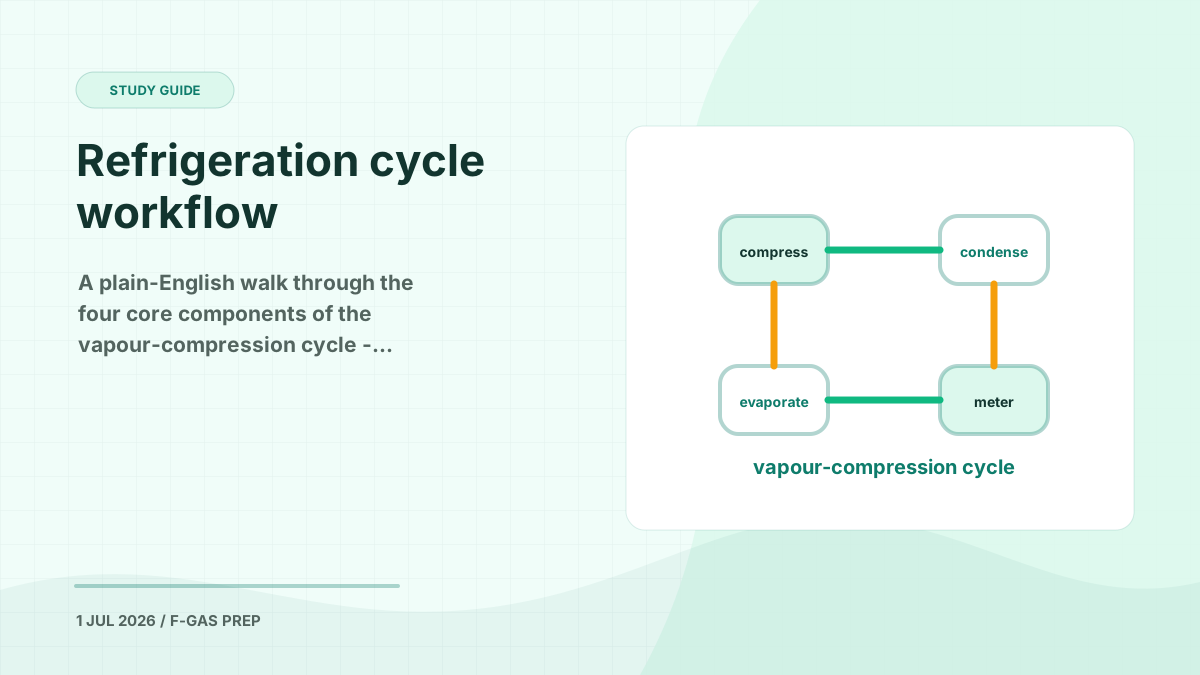
If you strip away the branding, the electronics and the marketing, every domestic fridge, cold store and split air conditioner runs on the same four-stage loop. Master that loop and you have the backbone of your F-Gas knowledge — and the foundation the City & Guilds 2079 assessment keeps circling back to. This guide follows a HVAC School explainer on the basic refrigerant circuit and translates it into the language your assessor will want to hear.
Two Principles That Explain Everything
Before we touch a single component, two rules govern the whole process:
- Heat always moves from hotter to colder. A hot cup of coffee cools in a cold room because heat leaves the coffee. It only stops moving when both reach the same temperature.
- Pressure and temperature travel together. Raise the pressure of a gas and its temperature rises; drop the pressure and the temperature falls.
“Higher pressure means higher temperature and vice versa — these principles guide the entire refrigeration process.”
As the video puts it, our goal is simple: “to move heat from a place we don’t want it to a place where it doesn’t bother us.” In a freezer that means shifting heat out of the food and into the room. In an air conditioner it means moving heat from inside the building to outside. Nothing is “making cold” — we are only relocating heat.
Sensible Heat vs Latent Heat
This distinction earns marks on the exam, so get it straight now.
- Sensible heat changes the temperature of a substance. You can measure it with a thermometer.
- Latent heat changes the state of a substance without changing its temperature. When water boils it stays at 100°C (212°F) while it absorbs the energy needed to become steam.
“The word latent just means hidden, because we can’t measure it with a thermometer — but we know the heat is contributing to the change from liquid to gas or gas to liquid.”
The refrigerant circuit deliberately exploits latent heat. Boiling and condensing move far more heat, far more quickly, than a simple temperature change ever could. That is why the refrigerant is chosen to change state at exactly the right points in the loop.
The Four Components
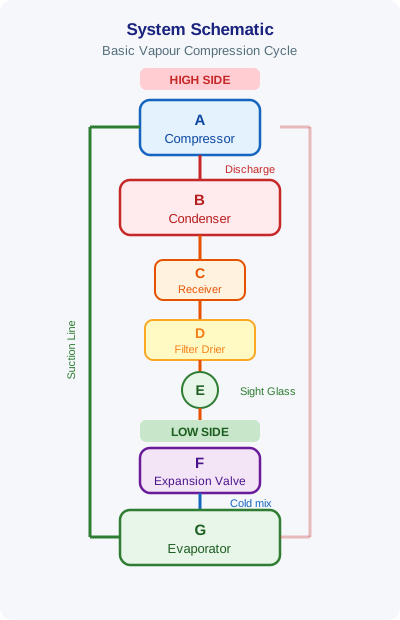
Learn these four jobs and you can describe any vapour-compression system:
- Compressor — the pressure increaser. The heart of the system. It squeezes the refrigerant molecules together, raising pressure and temperature, and pumps refrigerant around the circuit.
- Condenser — the heat rejector. It must be hotter than the air passing over it so heat can flow outward. Here the high-pressure vapour releases its heat and condenses to a liquid.
- Metering device — the pressure decreaser. It drops the pressure sharply, which triggers boiling and cools the refrigerant right down before the evaporator.
- Evaporator — the heat absorber. It must be colder than the air passing over it so it can pull heat in. Here the low-pressure liquid boils and absorbs heat, cooling the space.
“Remember: for heat to be absorbed, the evaporator must be a lower temperature than the air moving over it, because heat moves from hot to cold.”
Following the Refrigerant Around the Loop
Let’s take one lap, starting at the compressor.
- Cool vapour enters the compressor. The molecules are moving slowly. The compressor smashes them together, so they speed up and heat up. Refrigerant leaves hot and under high pressure.
- The condenser rejects that heat. The hot vapour gives up its heat to the surroundings and condenses into a high-pressure liquid. Put your hand over an outdoor split-system unit and you feel that rejected heat blowing out — it is the heat that used to be inside the building.
- The metering device drops the pressure. This sudden fall starts the boiling — often called flashing — which cools the refrigerant further and prepares it for the evaporator. The device might be a thermostatic expansion valve (TEV/TXV), an electronic expansion valve, a piston or a capillary tube — but its job is always the same: drop the pressure.
- The evaporator absorbs heat. The cold liquid boils at a very low temperature, pulling heat out of the indoor air (in AC) or out of the food (in refrigeration). This is where cold air is actually produced.
“Unlike water that boils hot, the refrigerant in our system boils cold. It absorbs heat from its surroundings when it’s boiling.”
The now-vaporised refrigerant returns to the compressor, and the cycle begins again — continuously, day and night.
Why Pressure Control Is the Whole Game
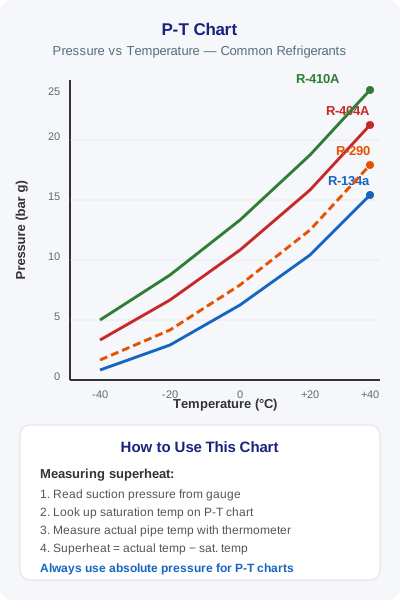
The engineer’s real lever is pressure. Because pressure and temperature are locked together, we choose where the refrigerant boils and condenses simply by setting the pressures:
- Low pressure = low temperature in the evaporator, so it can absorb heat from a cold space.
- High pressure = high temperature in the condenser, so it can reject heat even to warm outdoor air.
This is why an F-Gas technician lives by the pressure–temperature (P-T) chart. Reading a gauge pressure and converting it to a saturation temperature is how you calculate superheat and subcooling, diagnose an under- or over-charge, and confirm a system is running correctly before you sign it off.
The F-Gas Regulation Angle
Understanding the cycle is not just theory — it underpins the legal duties in the F-Gas Regulation. The current EU F-Gas Regulation (EU) 2024/573 (which repealed and replaced Regulation 517/2014, retained in Great Britain), together with the GB scheme, requires that anyone installing, servicing, maintaining or decommissioning stationary equipment containing fluorinated greenhouse gases holds the relevant certification.
That competence rests directly on the fundamentals above:
- Leak checking (Article 4 duties) demands you know what “normal” pressures and temperatures look like, so you can spot the abnormal.
- Refrigerant recovery (Article 8) requires you to understand phase change — you are pulling vapour and liquid out of a system safely, without venting.
- Charge and containment decisions depend on reading superheat and subcooling correctly, which is impossible without the P-T relationship.
In short, the four-component loop is the mental model behind almost every regulatory obligation you will be assessed on.
How This Maps to City & Guilds 2079
The 2079 assessment is built around practical skill groups, and the basic circuit threads through most of them:
- System operation and components — describing the role of the compressor, condenser, metering device and evaporator.
- Leak testing and system integrity — using pressure and temperature to judge system health.
- Refrigerant recovery, charging and handling — applying phase-change knowledge safely.
- Environmental awareness — understanding why containment matters and how the regulation frames it.
Expect the theory paper to test the why (sensible vs latent heat, why refrigerant boils cold) and the practical assessment to test the how (gauges, brazing, recovery, leak detection).
How F-Gas Exam Prep Fits Into This
Reading about the cycle is one thing; recalling it under exam pressure is another. The F-Gas Exam Prep app is built to close that gap:
- 460+ exam questions across every City & Guilds 2079 skill group, including dedicated refrigeration-fundamentals questions on the very components covered here.
- Mock exams that mirror the real 2079 format, so the timing and question style feel familiar on the day.
- AI voice challenges that quiz you out loud on superheat, subcooling and component roles — ideal revision for the drive to site.
- Detailed explanations for every answer, so when you get the pressure–temperature relationship wrong, you learn why rather than just memorising the correct option.
Get the fundamentals of this loop rock-solid, back them with regular practice, and both the theory and practical sides of your F-Gas assessment become far more predictable. The cycle never changes — make sure your understanding of it doesn’t wobble either.
Start Practising Today
Download the F-Gas Exam Prep app and study with 460+ practice questions, mock exams, and detailed explanations.