How to Pass Your F-Gas Certification Exam: Complete Guide
Everything you need to know about passing the F-Gas certification exam, including study tips, exam format, and preparation strategies for HVAC technicians.
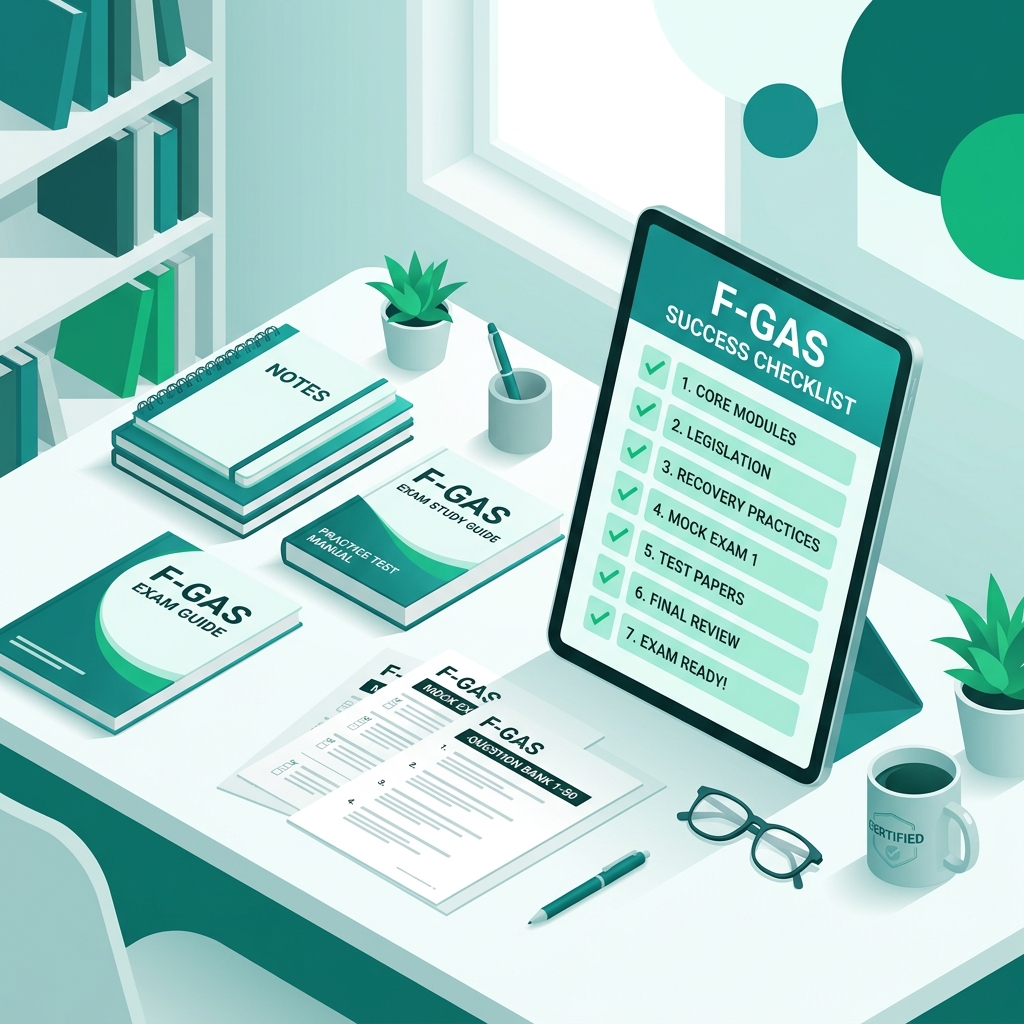
Why F-Gas Certification Matters
If you work with fluorinated greenhouse gases in the UK — whether installing, maintaining, servicing, or decommissioning refrigeration, air conditioning, or heat pump equipment — you generally need an appropriate F-Gas qualification to carry out that work lawfully. Passing the assessment is therefore not optional; it is a professional necessity.
This guide walks you through the exam format, how to prepare effectively, and what to expect on the day itself.
The Exam Format: City & Guilds 2079
One widely used F-Gas qualification route in Great Britain is City & Guilds 2079. For the current 2079-11 Category I knowledge test, the exam looks like this:
- Number of questions: 40 multiple-choice questions
- Time allowed: 80 minutes
- Pass mark: 24 marks out of 40
- Exam type: Closed book — no notes, textbooks, or reference materials allowed
- Delivery: Typically computer-based at an approved assessment centre
The questions cover a broad range of topics drawn from current Great Britain F-Gas rules, safe handling of refrigerants, environmental impact, system components, leak checking procedures, recovery and recycling, and relevant health and safety legislation.
How to Prepare: Proven Study Strategies
1. Understand the Syllabus Structure
The exam is divided into skill groups that map to the certification category you are sitting for. For Category I (full scope), you need to cover all skill groups. Familiarise yourself with the official syllabus breakdown so you know exactly what topics carry the most weight.
2. Focus on Regulations First
A significant portion of the exam tests your legal and environmental knowledge, including the HFC phase-down, Global Warming Potential (GWP), record-keeping requirements, leak checking obligations, and recovery duties. Many candidates underestimate how many questions come from this area. Study the applicable rules thoroughly.
3. Learn the Refrigerant Properties
You should be able to identify common refrigerants by their R-number designations, know their GWP values, understand whether they are flammable or toxic, and recognise their safety classifications under EN 378. Key refrigerants to know include R-410A, R-32, R-134a, R-404A, R-407C, and R-290 (propane).
4. Master Leak Checking Procedures
Leak checking is a core competency for F-Gas certified technicians. Know the mandatory leak check frequencies based on system charge size (in CO2 equivalent tonnes), the methods used for direct and indirect leak detection, and the record-keeping requirements that apply.
5. Use Practice Questions
There is no substitute for practising with mock exam questions. Working through practice papers helps you identify weak areas, get comfortable with the question style, and build confidence with time management. Aim to consistently score above 70% on practice tests before sitting the real exam.
6. Revise the Pressure-Enthalpy Diagram
Understanding the basic refrigeration cycle and how it maps onto a pressure-enthalpy (P-h) diagram is important. You should be able to identify the four main processes: compression, condensation, expansion, and evaporation. Know what happens to the refrigerant at each stage in terms of pressure, temperature, and state.
7. Study in Short, Focused Sessions
Research consistently shows that shorter study sessions with breaks are more effective than marathon cramming. Aim for 30 to 45 minute focused study blocks, and review material over several days rather than trying to absorb everything the night before.
What to Expect on Exam Day
Arrive at the assessment centre at least 15 minutes early. You will need to bring valid photo identification (passport or driving licence). Mobile phones and personal belongings are typically stored in a locker before you enter the exam room.
Once seated at the computer, you will have a brief tutorial screen explaining how to navigate the exam interface. The 80-minute timer begins when you start the first question. You can flag questions to review later and navigate back and forth through the exam.
Key exam day tips:
- Read each question carefully — pay attention to words like “not,” “except,” and “always”
- Eliminate obviously wrong answers first to improve your odds on uncertain questions
- Do not spend more than two minutes on any single question; flag it and move on
- Use any remaining time to review flagged questions
- Trust your preparation — your first instinct on a question is often correct
After the Exam
Results are typically available shortly after completion, sometimes on the same day. If you pass, City & Guilds issues the qualification. That gives you the personal evidence of competence, but it does not remove any separate company-certification requirements that may apply to the business carrying out the work.
If you do not pass on your first attempt, do not be discouraged. Review the areas where you scored lowest, study those topics in more detail, and rebook the exam when you feel confident.
Final Thoughts
The F-Gas exam is challenging but entirely passable with proper preparation. Focus your study time on regulations, refrigerant properties, leak checking, and the refrigeration cycle. Use practice questions extensively, and approach the exam day with calm confidence. Your F-Gas certification opens the door to legal compliance and professional credibility in the HVAC and refrigeration industry.
Related Study Topics
Environmental Impact & Regulations
EU F-Gas Regulation 517/2014, ozone depletion, global warming potential, phase-down schedules, and environmental compliance requirements.
Skill Group 4Leakage Checks & Detection
Methods of leak detection, mandatory checking frequencies, record keeping requirements, and threshold values under the F-Gas regulation.
Skill Group 1Basic Thermodynamics
Fundamental physics of refrigeration including SI units, pressure, temperature, heat transfer, and energy concepts essential for understanding HVAC systems.
Cross-cuttingHealth & Safety
Safe handling of refrigerants, personal protective equipment, ventilation requirements, first aid procedures, and cylinder safety.
Start Practising Today
Download the F-Gas Exam Prep app and study with 460+ practice questions, mock exams, and detailed explanations.