Understanding the Refrigeration Cycle: Superheat, Subcooling and Saturation Explained
Master superheat, subcooling and saturation across the refrigeration cycle to charge and troubleshoot systems with confidence for your F-Gas assessment.
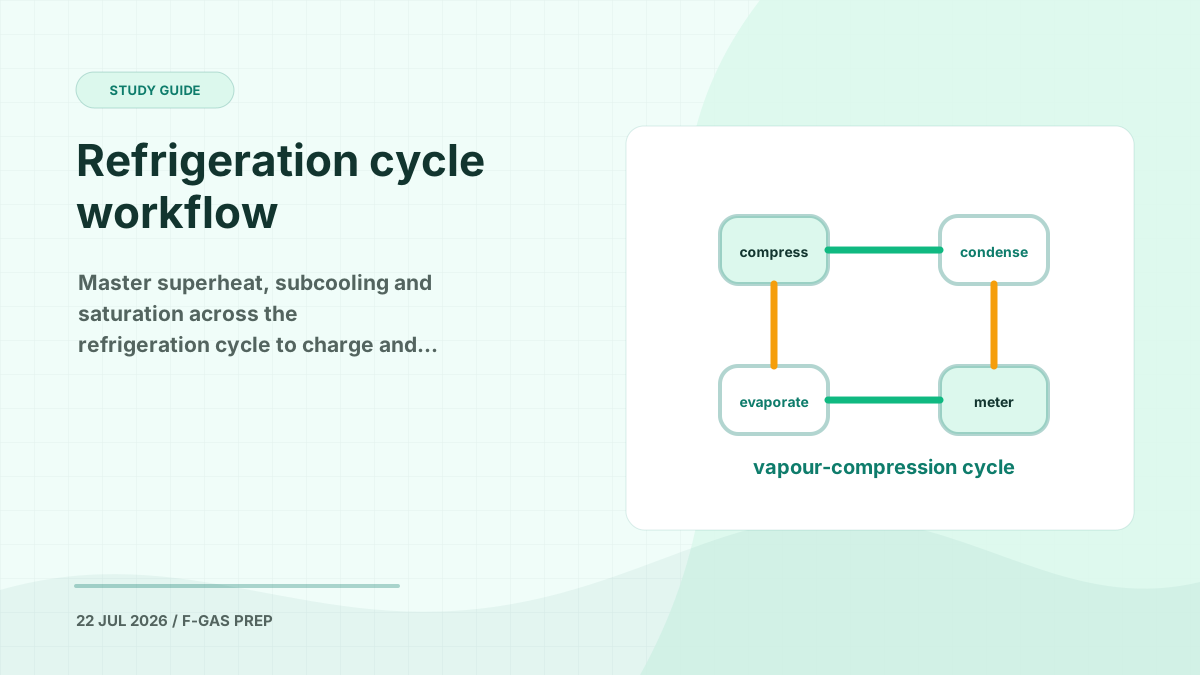
Every time you connect a gauge set to a heat pump or air conditioning system, you should be picturing the refrigeration cycle laid out over the top of the machine in front of you. As Craig Migliaccio puts it in this walkthrough from AC Service Tech, thinking in terms of the refrigerant state at every point isn’t just useful for checking the charge — it lets you troubleshoot a system remarkably quickly. For anyone preparing for the City & Guilds 2079 or working under EU F-Gas Regulation 517/2014, that mental model is the foundation everything else is built on.
Let’s walk the cycle the way an experienced engineer would, and tie each stage back to what the F-Gas assessment expects of you.
The Four Refrigerant States
Before you can diagnose anything, you need to recognise the four states the refrigerant moves through as it travels round the circuit:
- Low pressure, low temperature vapour — the suction gas entering the compressor
- High pressure, high temperature vapour — the discharge gas leaving the compressor
- High pressure, high temperature liquid — the subcooled liquid leaving the condenser
- Low pressure, low temperature liquid — the refrigerant after the metering device
“Vapour means gaseous state — it just means that there is no liquid, it’s not saturated. And saturated means liquid and vapour at the same time in a mix.”
That distinction between vapour, liquid and saturated is the single most important idea in the whole video, and it appears repeatedly in the EPA 608 and City & Guilds terminology you’ll be tested on.
Following the Cycle Round
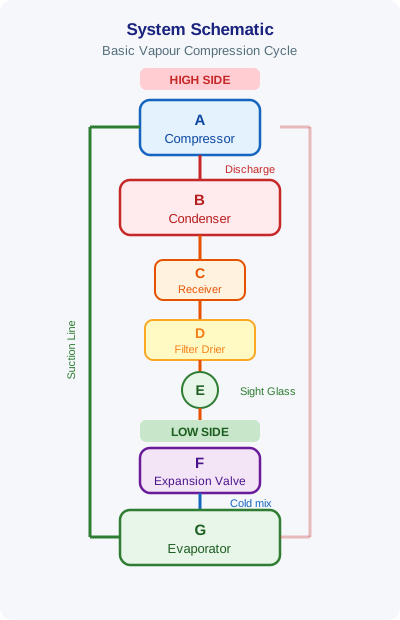
Starting at the compressor inlet, low pressure vapour enters the scroll compressor. The compressor’s job is simple to state: increase pressure so that temperature increases. As Craig reminds us, any time you increase pressure you increase temperature, and vice versa — a relationship you’ll meet again on the pressure-temperature chart.
At the compressor outlet, you now have high pressure, high temperature vapour heading into the discharge line — the hottest line on the entire system. In a heat pump it passes through the reversing valve unchanged before reaching the condenser.
Inside the condenser coil, three things happen in sequence:
- De-superheating — the hot vapour sheds sensible heat and drops in temperature
- Saturation (phase change) — the refrigerant holds a constant temperature (say 105°F / ~40°C in the example) while it changes from vapour to liquid, moving from 95% vapour, through a 50/50 mix, to 95% liquid
- Subcooling — once fully liquid, the refrigerant continues to reject heat and drops below its saturation temperature
“The phase change of the refrigerant — that’s the secret to this whole thing even working.”
That phase change is exactly why a refrigerant can move so much heat. Craig’s ice-cube analogy is worth remembering: a glass of 32°F water warms up quickly, but an ice cube stays at 32°F far longer because it absorbs a large quantity of latent heat as it changes state.
Measuring Subcooling and Superheat
Subcooling is the temperature difference between the saturation temperature in the condenser and the actual liquid line temperature. In the worked example, 105°F saturation minus a 93°F liquid line reading gives 12 degrees of subcooling. You then compare that against the figure stamped on the rating plate (for example, “R-410A TXV subcooling 12°F”).
“When you add refrigerant, your saturated temperature is going to increase and your liquid line temperature is going to decrease — and then that spread is called the subcooling.”
On the low side, after the metering device drops the pressure, the refrigerant enters the evaporator already saturated. It holds its low temperature through the coil, then — once fully evaporated — begins superheating. Measure the vapour line pressure, convert it to a saturation temperature, and subtract it from the measured line temperature. A 54°F line reading over a 42°F saturation temperature gives 12 degrees of total superheat.
The rule for which method to use is straightforward:
- Fixed orifice / piston metering device → charge by total superheat
- Thermostatic expansion valve (TXV/TEV) → charge by subcooling
But the professional habit — and the one that will serve you well in an F-Gas assessment scenario — is to check both. If you see high superheat with correct subcooling, you’re likely looking at a liquid line restriction or a TXV stuck nearly closed, perhaps from a leaking sensing bulb.
Moisture, Oil and Compressor Protection
The video’s detour through the filter drier is more than incidental — it goes to the heart of good refrigerant handling under F-Gas rules. The bi-flow drier traps water vapour so it can’t mix with the POE oil common in R-410A systems.
“POE oil mixed with water is going to create alcohol and acids… it’s going to eventually lead to a compressor burnout.”
Because refrigerant and oil circulate together and pass over the motor windings of a hermetically sealed compressor, acidic oil attacks the winding insulation and eventually causes a short. This is precisely why you always fit a new filter drier when you open a system, and why it’s the last component installed. It also underlines why a poor evacuation — an inadequate vacuum pull-down — leaves moisture in the system that the drier can only partly absorb.
Heat Pump Mode and the Reversing Valve
Reverse the refrigerant flow and the same principles apply — the indoor coil becomes the condenser and the outdoor coil the evaporator. The accumulator becomes critical here: when the outdoor coil frosts up below around 40°F (4°C), the refrigerant may never fully superheat and can leave the coil still saturated. The accumulator safeguards the compressor, storing liquid and allowing only vapour to pass on.
If you suspect a partially stuck reversing valve, measure across the two low pressure, low temperature tubes — never the scorching high pressure lines, which can damage your sensor and give misleading readings if one tube is poorly insulated.
How F-Gas Exam Prep Fits Into This
Superheat, subcooling and saturation aren’t abstract theory — they’re the language of safe charging, recovery and leak checking that the City & Guilds 2079 and EU F-Gas Regulation 517/2014 assessments are built around. The F-Gas Exam Prep app turns this understanding into exam-ready recall:
- 370+ exam questions spanning every skill group, including the refrigeration fundamentals covered here
- Mock exams that mirror the real City & Guilds 2079 format, so nothing on assessment day is a surprise
- AI voice challenges that let you talk through superheat and subcooling scenarios for genuinely interactive revision
- Detailed explanations for every answer, so you learn why a reading points to a liquid line restriction rather than simply memorising it
Learn to picture the cycle over the top of the system, practise reading it under exam conditions, and both your assessment and your fieldwork become far more straightforward.
Start Practising Today
Download the F-Gas Exam Prep app and study with 460+ practice questions, mock exams, and detailed explanations.