R-32 and R-454B Charge Checks: Subcooling and Superheat Explained
How to check the charge on R-32 and R-454B systems with the subcooling method, with worked examples, bubble and dew point readings, and F-Gas exam tips.
R-32 and R-454B are now the main replacements for R-410A in split air conditioning and heat pumps, and both are classed as A2L (mildly flammable). Many engineers want to know whether checking the charge on these systems is any different. The basic method is the same, but there are a few details that catch people out, both on site and in the City & Guilds 2079 assessment.
This post works through the four charging examples from a training video by AC Service Tech LLC. The video uses US units (psig and °F). We’ll keep those figures so the arithmetic matches, and give UK equivalents where they help. If you work in bar and °C, remember that a temperature difference of 1 K equals 1.8 °F.
Before You Measure Anything
Before taking any readings, check three things. If any of them is wrong, your figures won’t tell you much about the charge.
- Metering device: the subcooling method applies to systems with a thermostatic expansion valve (TEV) or an electronic expansion valve (EEV) at the indoor coil. On a fixed-orifice system you would charge to superheat instead.
- Airflow: confirm that the airflow across the indoor coil is correct for the system’s capacity. A dirty filter or a fan on the wrong speed will distort every reading.
- Run time and staging: run the system in cooling mode for at least 10 to 15 minutes. If it is a two-stage unit, make sure it is running on second stage.
The video also highlights a quick evaporator check:
“You just want to make sure that your saturated temperature is above 32° when you’re converting it from pressure to temperature.”
That means an evaporating temperature above 0 °C. At or below 0 °C, moisture from the air will freeze onto the indoor coil and you are diagnosing an icing problem rather than a charge problem.
The Subcooling Method in Brief
Subcooling measures how far the liquid leaving the condenser has been cooled below its saturation temperature. It is a direct indication of how much of the condenser is filled with liquid refrigerant.
Subcooling = saturated condensing temperature (from liquid line pressure) − measured liquid line temperature
Compare your result with the target subcooling on the outdoor unit’s rating plate. Some units list several targets that vary with outdoor temperature. A reading within about ±3 °F (roughly ±1.5 to 2 K) of the target is generally considered correctly charged.
- Subcooling well above target: the system is overcharged and liquid is backing up in the condenser.
- Subcooling well below target: the system is undercharged, and the TEV may not be receiving a solid column of liquid.
R-32 Worked Example: Correctly Charged
This system has been running steadily with good airflow.
| Measurement | Value |
|---|---|
| Suction (vapour) pressure | 116.3 psig → 38 °F saturated |
| Liquid line pressure | 374.9 psig → 110 °F saturated |
| Liquid line temperature | 100 °F |
| Suction line temperature | 48 °F |
| Target subcooling (rating plate) | 11 °F |
- Subcooling: 110 − 100 = 10 °F (about 5.6 K), which is within tolerance of the 11 °F target.
- Superheat: 48 − 38 = 10 °F, which is inside the 8 to 12 °F range a TEV should normally hold.
Superheat Confirms the TEV Is Working
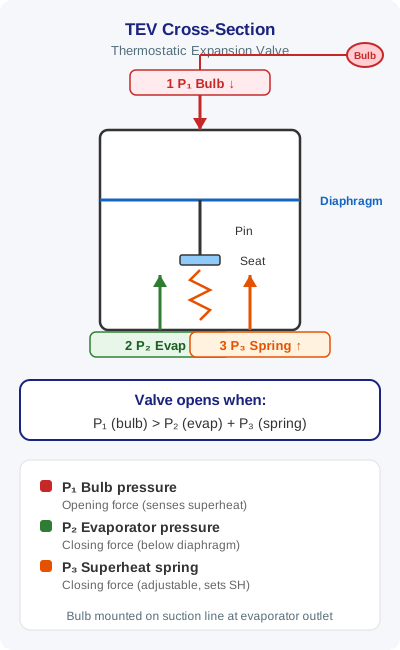
The video makes an important point about how the TEV works:
“The thermostatic expansion valve cannot do its job unless you have proper air flow and the proper amount of refrigerant in the system.”
The valve balances three forces: bulb pressure on top of the diaphragm, and evaporator or external equaliser pressure plus spring pressure underneath. If the liquid line has no subcooling, flash gas reaches the valve and it can’t hold a stable superheat. This topic comes up often in 2079 questions on expansion devices.
R-32 Scenario: Two-Stage System
This unit is a two-stage outdoor unit running on second stage, and the target subcooling is 11 °F.
- Saturated condensing temperature: 102 °F
- Liquid line temperature: 98 °F
- Saturated suction temperature: 36 °F
- Suction line temperature: 50 °F
Answer: undercharged. Subcooling is 102 − 98 = 4 °F, which is 7 °F below target. Superheat is 50 − 36 = 14 °F, slightly high, which also points to a starved evaporator.
R-32 is a single-component refrigerant, so you can add it to the running system on the suction side as vapour. You can also charge it as liquid if you meter it in slowly. Before adding any refrigerant, though, remember what the video says about A2L systems:
“You really want to find and fix the leak before you are adding refrigerant into one of these A2L systems.”
Under Article 3 of F-Gas Regulation 517/2014, a detected leak must be repaired without undue delay. Topping up a leaking system is not compliance. Many A2L indoor units also have refrigerant leak sensors. When a sensor trips, the unit stops the compressor and runs the indoor fan to disperse the gas, so a slow leak will soon show up as a call-out anyway.
R-454B: Bubble Point and Dew Point

R-454B is a blend of R-32 and R-1234yf. Because it is a zeotropic (400-series) blend, its PT chart has two columns:
- Bubble point (liquid column): use this at the condenser and liquid line to calculate subcooling.
- Dew point (vapour column): use this at the evaporator and suction line to calculate superheat.
R-454B’s temperature glide is small, but using the wrong column will still put your readings out. Exam questions on zeotropic blends often test exactly this.
R-454B Worked Example: Slightly Low
This is a single-stage heat pump in cooling mode with a TEV, after 15 minutes of run time. The target subcooling is 12 °F.
| Measurement | Value |
|---|---|
| Liquid line pressure | 338.3 psig → 104 °F (bubble) |
| Liquid line temperature | 96 °F |
| Suction pressure | 115.6 psig → 44 °F (dew) |
| Suction line temperature | 56 °F |
- Subcooling: 104 − 96 = 8 °F. That is 4 °F under the target, so the system is slightly low on charge. The acceptable window here is about 9 to 15 °F.
- Superheat: 56 − 44 = 12 °F. The TEV is still controlling.
R-454B Scenario: Two-Stage Heat Pump
This is a new installation with a short line set, running on second stage for 20 minutes. The indoor temperature is above 21 °C and the outdoor temperature above about 32 °C. The target subcooling is 9 °F.
- Saturated liquid (bubble) temperature: 118 °F
- Liquid line temperature: 102 °F
- Saturated suction (dew) temperature: 44 °F
- Suction line temperature: 52 °F
Answer: overcharged. Subcooling is 118 − 102 = 16 °F, which is 7 °F above target. Superheat is 52 − 44 = 8 °F, at the low end of the range. Too much liquid is backing up in the condenser.
Recovering and Adding Refrigerant Correctly
The fix for an overcharge is recovery, and the regulations apply here too:
- Article 8 of Regulation 517/2014 requires F-gases to be recovered by certified personnel. They must never be vented.
- Use a dedicated recovery cylinder for each refrigerant. The video puts it simply:
“You’ll have one for R454B, you’ll have one for R32, another one for R410A.”
Mixing refrigerants in a recovery cylinder contaminates the whole batch, and the mixture usually can’t be reclaimed. With A2L refrigerants, the cylinder and recovery machine must also be suitable for flammable refrigerants. Don’t exceed the cylinder’s safe fill limit.
When adding R-454B, invert the cylinder so the refrigerant leaves as liquid and the blend’s composition is preserved. Meter it in slowly, or use a flashing device. The suction service port is usually close to the compressor, and liquid slugging can damage it.
Leak Checks and CO₂ Equivalent Thresholds
The lower GWPs of these refrigerants change your leak-checking obligations. Under Article 4 and Annex I of 517/2014 (AR4 values), the thresholds are:
| Refrigerant | GWP | Charge equal to 5 tCO₂e |
|---|---|---|
| R-410A | 2,088 | ≈ 2.4 kg |
| R-32 | 675 | ≈ 7.4 kg |
| R-454B | 466 | ≈ 10.7 kg |
Most domestic split systems on R-32 or R-454B fall below the 5 tCO₂e leak-check threshold. However, the duty under Article 3 to prevent leaks and repair them promptly applies regardless of charge size. Recording the charge you add or remove is still good practice.
The video mentions US EPA 608 certification. In the UK, the requirement is F-Gas certification under Article 10, typically City & Guilds 2079 Category I for full scope. Because these refrigerants are flammable, you should also have additional training in A2L handling and BS EN 378.
How F-Gas Exam Prep Fits Into This
Charge diagnosis like this appears throughout the City & Guilds 2079 assessment. It comes up in questions on reading gauges and PT charts, TEV operation, zeotropic blends and glide, recovery procedures, and the regulatory duties in Articles 3, 4, 8 and 10.
The F-Gas Exam Prep app helps you practise exactly these topics:
- 370+ exam questions across all skill groups, covering subcooling, superheat, refrigerant properties, leak checking and recovery
- Mock exams that mirror the real City & Guilds 2079 format, so the timing and question styles are familiar on the day
- AI voice challenges for interactive revision, useful for talking through a charging scenario as you would with an assessor
- Detailed explanations for every answer, so you learn why high subcooling with low superheat points to an overcharge rather than memorising the answer
Work through the four scenarios above, then test yourself in the app. The aim is to diagnose a system’s charge quickly and correctly, both on site and in the exam.
Start Practising Today
Download the F-Gas Exam Prep app and study with 460+ practice questions, mock exams, and detailed explanations.

