Refrigeration Basics: The Fundamentals Every F-Gas Technician Must Master
A back-to-basics walkthrough of pressure, temperature, heat and the gas laws behind the refrigeration cycle — and why they transform your diagnostic skills.
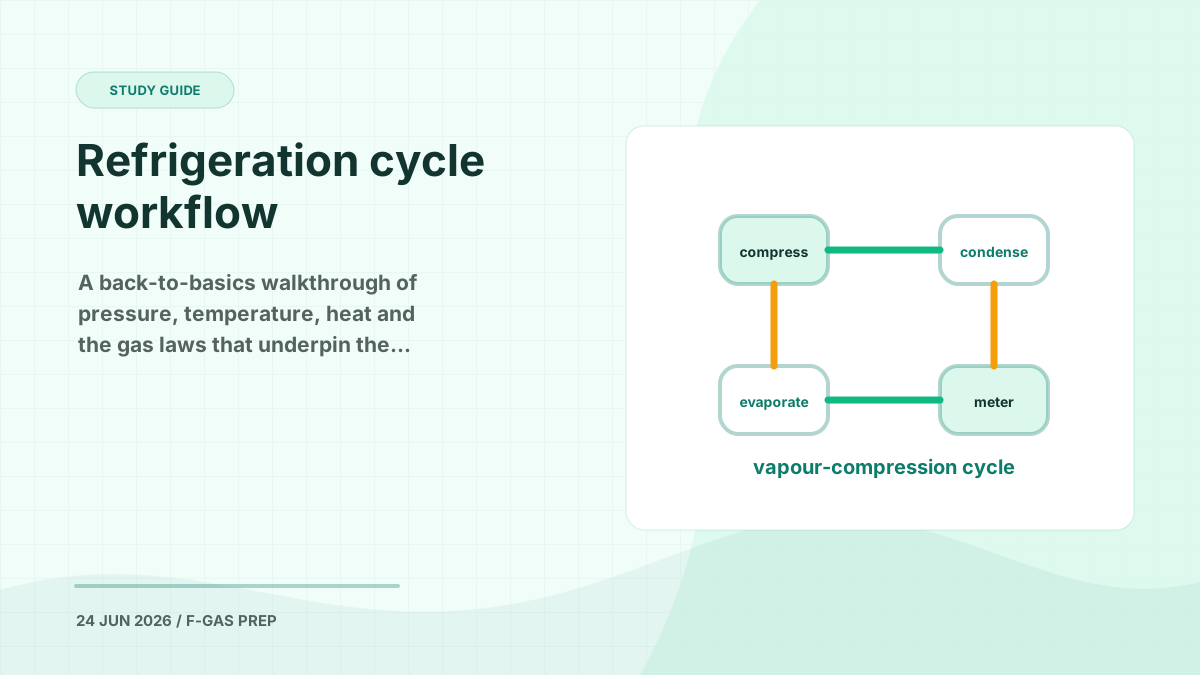
There are layers to refrigeration. You can memorise the circuit and the line names in your first month — but it can take years before that knowledge becomes something you actually use to solve problems. The technicians who get unstuck are the ones who go back to the absolute basics and build up properly. Once you genuinely understand the cycle, someone can give you a couple of pressures and temperatures over the phone and you can picture exactly what is happening inside the whole system — even pointing them towards a fault they haven’t checked yet.
This post follows a back-to-basics training session and translates it for anyone preparing for the City & Guilds 2079 / F-Gas assessment. We start with pressure, build through temperature and heat, and finish with the gas laws that make the cycle work.
“The refrigerant circuit is this piece of cool science and chemistry that — it is a balanced system, everything affects everything in it.”
The Four Main Components
Every refrigeration system, from a domestic split to commercial rack refrigeration, is built around the same four components:
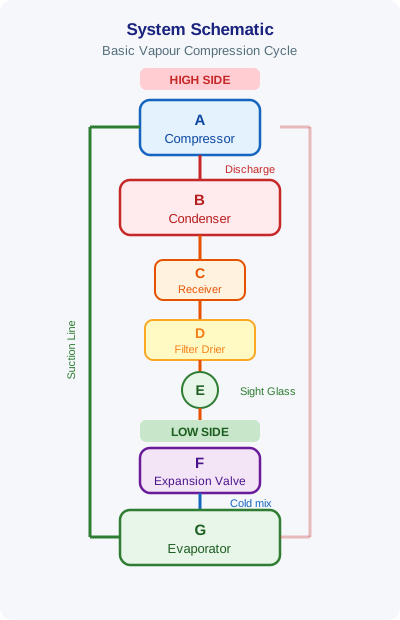
- Compressor — the heart of the system. It turns the refrigerant into a high-pressure, high-temperature vapour.
- Condenser — the vapour passes through, rejects heat, and condenses to a high-pressure liquid.
- Expansion (metering) device — drops the pressure, producing a low-pressure, low-temperature liquid-vapour mixture.
- Evaporator — absorbs heat from the indoor air; the refrigerant leaves as a low-pressure, low-temperature vapour.
A useful tip for describing the flow: start at a component, not at a state of refrigerant. Beginning at the compressor and walking round the loop keeps your description in order.
One refinement worth memorising: a saturated liquid is 100% liquid at its saturation temperature. The actual phase-change region inside the condenser is the saturated mixture region, where liquid and vapour coexist. Once condensation is complete, any further heat removal produces subcooling.
“It’s okay to memorise at first before you understand it — it will help you, because then the language is in you.”
Pressure: What Your Gauges Are Really Telling You
Pressure is simply force applied over an area. In the field we measure the pressure the refrigerant exerts on its container — the copper tubing — using our gauges and probes.
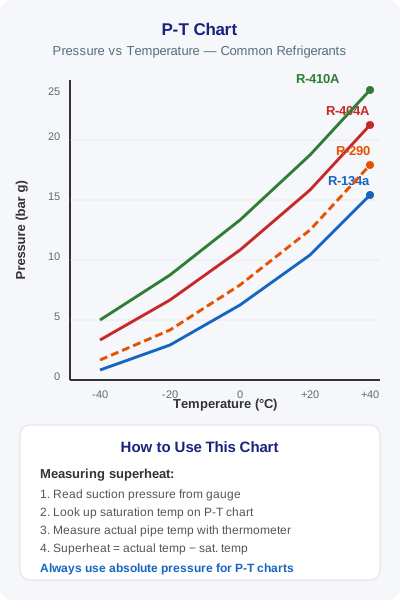
There are two scales you must keep straight:
- Gauge pressure (PSIG) — what your manifold gauges and probes read. They already account for atmospheric pressure (14.7 PSI at sea level), so they read zero when open to the air.
- Absolute pressure (PSIA) — used in lab testing and on some published PT charts. It does not subtract atmospheric pressure.
This catches technicians out. If you pull a PT chart online and it is in PSIA, then where it says “14 PSI” your gauges would actually read zero. Always check the header of the chart. PSIA also turns up when calculating a compressor’s compression ratio.
“We live at the bottom of an ocean of air… the gauges just start at zero — they don’t show that we’re living in 14 PSI.”
Pull below zero PSIG and you are into a vacuum, which is what makes space so hostile — it is not pressurised. We never reach a true, total vacuum; we just go lower than the 14.7 PSI we live in.
Three pressure scales for the field
Different magnitudes call for different units:
- Refrigerant pressure → PSI
- Vacuum → microns of mercury. In refrigeration vacuum work, a micron means one-thousandth of a millimetre of mercury. When evacuating a system you need that fine resolution to confirm you’ve reached your target.
- Air pressure / static pressure in ductwork → inches of water column, measured with a manometer (not a gauge). The pressure of moving air is real — it’s what fights you when you pull a panel — but it is a tiny fraction of one PSI.
Temperature Is Not Heat
This is the idea that reshapes how you think about the whole trade.
Temperature is a measure of the average molecular velocity — how fast the molecules are moving. Slow molecules (an ice cube) = low temperature; fast, bouncing molecules (boiling water) = high temperature.
Heat is the total thermal energy in a substance — and it is not the same as temperature. There is no such thing as “cold”; there is only the absence of heat. An ice cube still contains heat energy.
In our world this means a suction line can feel ice-cold to the touch and yet be carrying all the heat that was just removed from the conditioned space. In a live demonstration, technicians guessed a suction line was in the 40s and 50s Fahrenheit; the probe read it far colder than almost anyone expected — and that freezing line was loaded with heat.
“The same heat can be 47°F or 140°F — same heat. That’s what you need to take away from this.”
So our job is not to remove temperature. Our job is to move energy — heat — out of the space. We manipulate temperature only as the means to make that heat move.
Wet bulb and dry bulb
On the air side you’ll measure both dry bulb (DB) and wet bulb (WB) temperature. Wet bulb accounts for moisture in the air — the cooling effect of evaporation off a wetted sensor — and from it we derive relative humidity, which feeds calculations like target superheat. The split across a coil (return DB minus supply DB) tells you how much heat the air gave up: a healthy system typically drops the air around 20°F.
The Second Law of Thermodynamics
Strip away the jargon and the second law says something simple and powerful: heat always moves from hotter towards colder, until both reach a balance point — thermal equilibrium.
Drop an ice cube into a glass of water and the cube warms, the water cools, until everything sits at one temperature. Nature loves balance — you see it with pressure and you see it with heat.
There is a diminishing return built in. The greater the temperature difference, the faster heat moves; as the two sides converge, the transfer slows. That is exactly why we drive coil temperatures hard:
- A coil at 77°F facing 78°F room air will transfer heat — but agonisingly slowly and inefficiently.
- Get the coil roughly 35°F colder than the air and heat moves quickly, giving that ~20°F split off the coil.
We don’t go colder still (which would move heat even faster) because conditions change — a dirty filter, rain outside, a shift in charge — and a coil that was at 36°F today could hit 28°F tomorrow and freeze. So we hold the balance point up in the 40s for most comfort cooling. (Commercial freezer coils run below freezing and rely on a scheduled defrost cycle to shed the ice that forms.)
“We don’t make cold. We move heat from inside the house to outside the house, using natural laws to make it happen.”
The same principle — energy seeking equilibrium — governs electrical work too. A voltmeter doesn’t read “the electricity”; it reads the potential difference between two points. Measure across the same leg and you’ll see zero even on a live circuit; measure to ground and the difference appears. This is precisely why safety checks are always taken to ground, while diagnostic voltage checks are taken between lines.
The Ideal Gas Law: Why the Compressor Works
The ideal gas law is written PV = nRT, and Gay-Lussac’s law adds the part we care about most: for a fixed volume and quantity of gas, pressure and temperature are directly proportional.
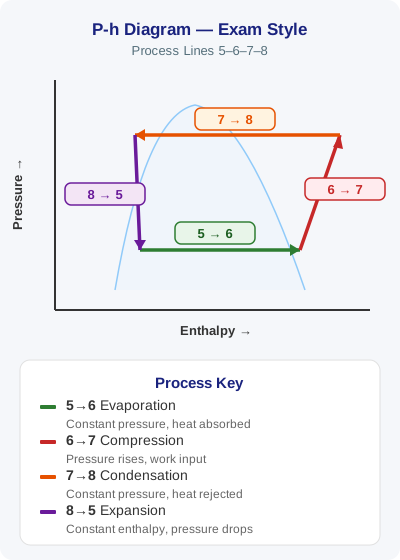
For field work you can ignore the volume and the constants and reduce it to:
Pressure ↔ Temperature. Raise one, the other must rise. Lower one, the other must fall.
That single relationship explains both halves of the cycle:
- The compressor raises pressure, which necessarily raises temperature. Picture molecules bouncing in a room; close in the walls and they collide faster — higher velocity, higher temperature — even though no heat was added. The compressor takes refrigerant that left the evaporator cold (say 48°F, loaded with heat) and drives it to perhaps 130°F. Now it is far hotter than the ~80°F outdoor air, so it can reject that heat in the condenser.
- The metering device is the mirror image — the pressure dropper. It lowers the pressure of the refrigerant so its temperature falls below the indoor air, allowing the evaporator to absorb heat again.
“To reject heat, the refrigerant must be hotter than the outdoor temperature — and the compressor’s job is to raise the temperature by ramping up the pressure.”
A crucial footnote: the compressor’s job is not to add heat. (Yes, the motor windings add a tiny amount as they’re cooled by the suction gas, but that’s incidental.) Its purpose is to manipulate temperature by changing pressure so that heat will move in the direction we need. The compressor creates the imbalance on the high side; the metering device creates it on the low side. Between them they let the natural laws do the actual work of moving heat.
How This Maps to Your F-Gas Assessment
For the City & Guilds 2079 / F-Gas route, this foundational understanding sits underneath several skill groups — particularly Basic Thermodynamics, Refrigeration System Components, and System Commissioning and Fault Finding. The exam expects you to:
- Explain the four-stage vapour-compression cycle and the role of each component
- Distinguish saturated, sub-cooled and superheated conditions
- Apply the pressure–temperature relationship using a PT chart
- Recognise the units used for refrigerant pressure, vacuum and airflow
The legal duties then layer on top — leak checking, leak-detection systems, record-keeping, and recovery obligations. None of those duties make sense until you can read what a system is doing thermodynamically, which is exactly why examiners test the fundamentals first.
How F-Gas Exam Prep Fits Into This
The fundamentals in this post are precisely what the F-Gas Exam Prep app is built to drill. Inside you’ll find:
- 460+ exam questions spanning every skill group, including thermodynamics, system components and fault finding
- Mock exams that mirror the real City & Guilds 2079 format, so the structure and timing feel familiar on the day
- AI voice challenges for interactive revision — talk through the cycle out loud, just like explaining it to a colleague in the van
- Detailed explanations for every answer, so when you get pressure-vs-temperature or PSIG-vs-PSIA wrong, you learn why — and it sticks
Memorise the circuit first, then build the understanding underneath it. Lay your ego aside, ask the question a third time if you need to, and let the fundamentals turn diagnostics from guesswork into something you genuinely enjoy.
Start Practising Today
Download the F-Gas Exam Prep app and study with 460+ practice questions, mock exams, and detailed explanations.