What Superheat Actually Signifies — Reading Your Evaporator Like an Engineer
Superheat is not just a number on a gauge set — it tells you how full the evaporator is with boiling refrigerant. Here is what that means in practice.
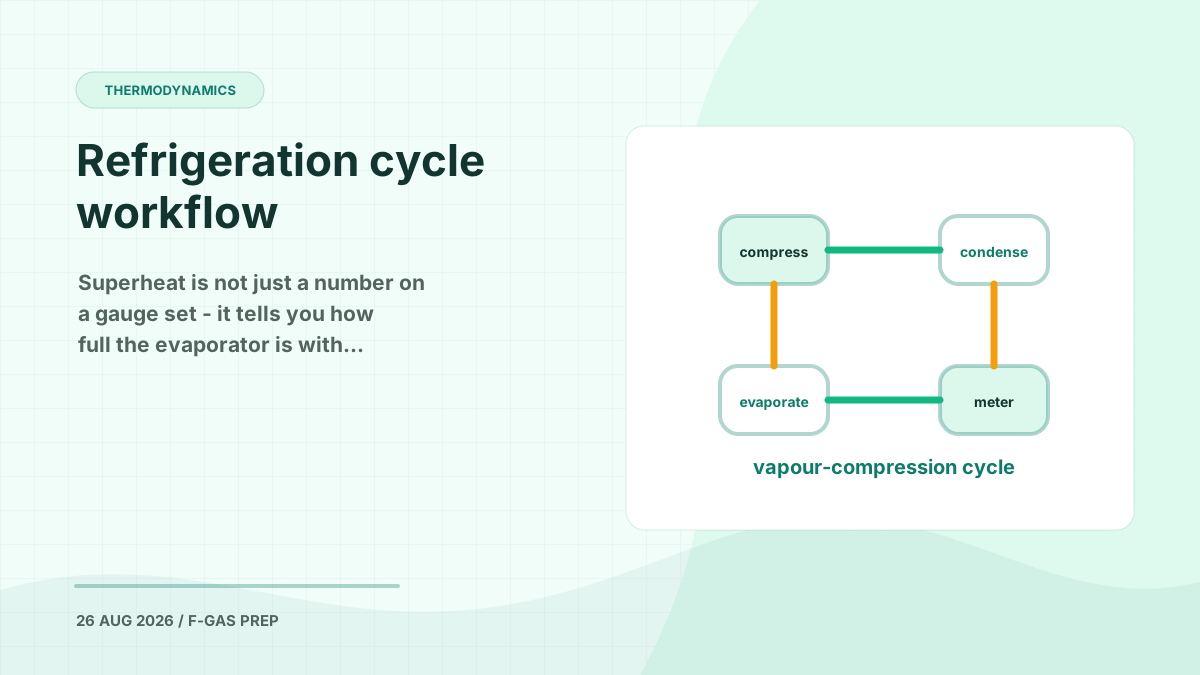
Ask a technician what superheat is and you will usually get the maths back: suction line temperature minus saturation temperature. That is how you calculate it. It is not what it is. Learning the arithmetic and learning the meaning are two very different exercises, and City & Guilds 2079 examiners have a habit of testing the second one.
This post walks through what superheat genuinely signifies inside the evaporator, why it sits at the heart of charge diagnosis, and how to use it alongside subcooling rather than instead of it.
- The definition that actually matters
- Two things you need to know about an evaporator
- Why evaporating temperature is not the whole story
- Lower superheat is more efficient — and more risky
- Where you measure changes what you read
- Superheat as a diagnostic, not a charging method
- What this means for your 2079 assessment
The Definition That Actually Matters
The instructor in this session pushes his class past the textbook answers — “heat absorbed from the home”, “it’s above the boiling point”, “it tells you the TXV is working” — until he lands on the one that does the real work:
“Superheat is a measurement of how full the evaporator coil is with boiling refrigerant.”
Everything else follows from that. Liquid refrigerant enters the metering device, drops in pressure, and immediately begins to boil — roughly 70% liquid and 30% vapour on the outlet side of the expansion device. As it travels through the coil it continues boiling, and while any liquid remains it stays at a constant saturation temperature. Only once the last droplet has evaporated does the refrigerant start rising in temperature again. That temperature rise is superheat.
So a low superheat number tells you the boiling carried on almost all the way to the coil outlet. A high number tells you the boiling finished early and a large portion of the coil was left transferring only sensible heat into dry vapour — a far less effective process than latent heat transfer.
Two Things You Need to Know About an Evaporator
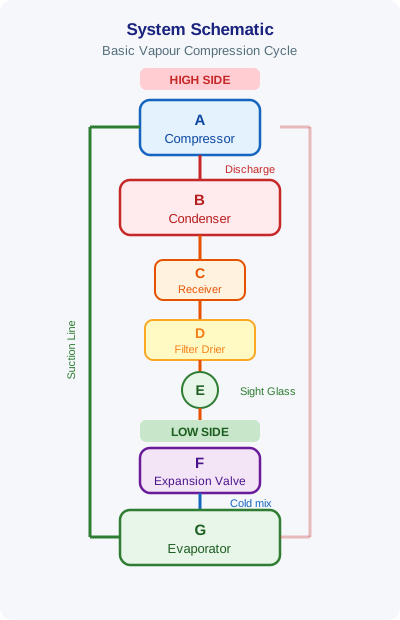
For any evaporator, there are only two questions worth asking:
- At what temperature is the refrigerant boiling? This is the evaporating temperature, and you find it from suction saturation — take the gauge pressure and convert it with a pressure-temperature chart or refrigerant app.
- How much of the coil is doing that boiling? That is superheat.
Notice the direction of flow that makes this work. A condenser is fed from the top and makes liquid at the bottom. An evaporator is fed at the bottom and vapour leaves from the top. Obvious once you see it, easy to miss for years if nobody points it out.
Note also that evaporating temperature is only real while the refrigerant is boiling. Quote a coil as running at 7 °C and you are describing the saturated portion only. The vapour leaving the coil outlet is warmer than that by exactly the amount of superheat.
Why Evaporating Temperature Is Not the Whole Story
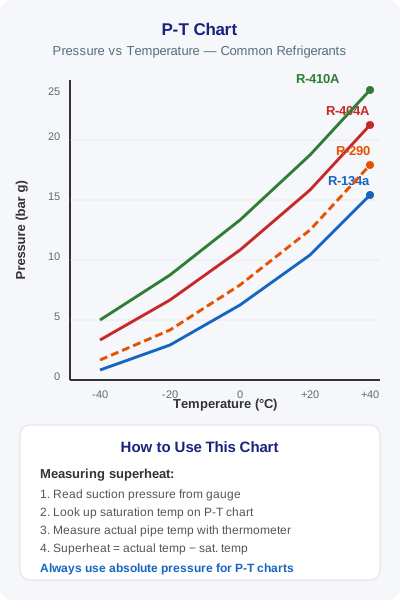
A colder evaporator dehumidifies better, but it comes at a thermodynamic cost, and the reasoning here is worth committing to memory for the exam:
- Lower suction pressure means the vapour molecules are further apart.
- Further apart means lower density — the gas is lighter.
- A compressor is a volumetric device. Every stroke of a reciprocating machine, or every orbit of a scroll, sweeps the same volume.
- Same volume × less mass per unit volume = less refrigerant mass circulated per revolution.
Less mass flow means less capacity and fewer units of cooling per watt of input. It also drives up compression ratio, which pushes discharge temperature higher and shortens compressor life.
“Everything that we do in the refrigerant cycle is a balancing act.”
That balancing act is exactly why not having enough refrigerant is a problem and having too much is also a problem; why a metering device that underfeeds is a fault and one that overfeeds is equally a fault. Stack more liquid in the condenser and you improve your chances of delivering pure liquid to the expansion device — but you also reduce effective condensing surface, raise condensing temperature and head pressure, and worsen compression ratio all over again.
This all assumes one thing: that the only substance in the system is the refrigerant you think it is. Air, moisture, nitrogen or a cross-contaminating refrigerant and, as the instructor puts it, all bets are off — the pressures you expect are not the pressures you get and nothing reads true. That is precisely why F-Gas Regulation (EU) 517/2014 places such weight on proper evacuation, recovery to Article 8 standards, and correct handling under Article 10 certification. Contaminated charge is not just a performance problem; it is a diagnostic blindfold.
Lower Superheat Is More Efficient — and More Risky
Given that lower superheat means a fuller, better-utilised coil, why not aim for 1 K and be done with it?
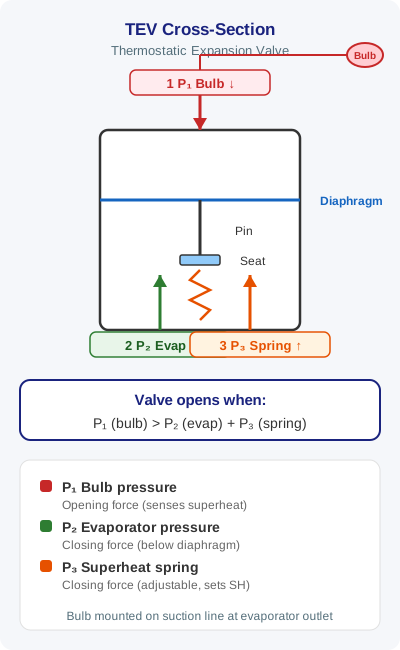
Because a thermostatic expansion valve has a minimum stable superheat. The valve balances bulb pressure against evaporator pressure and spring pressure, and it needs a working range to modulate within. Squeeze that range to nothing and the valve hunts, overfeeds, and delivers liquid back down the suction line to the compressor.
The analogy offered in the class is a good one:
“Has anybody ever seen those engine tuners you can get where you can get more horsepower out of your engine but you can also blow it up? Same thing is true here. The lower the superheat, the riskier we are.”
Typical figures discussed:
| Measurement point | Typical target | Notes |
|---|---|---|
| Evaporator coil outlet | 6–14 °F (roughly 3–8 K) | Where the metering device is actually controlling |
| TXV nominal setting | 10 °F ± 5 °F | Manufacturer’s stated valve range |
| Compressor suction inlet | Up to 20 °F acceptable | Compressor manufacturers commonly ask for around 20 °F here |
Note that these are Fahrenheit-based rules of thumb from a US training session; in UK and European practice you will be working in kelvin, so convert before you quote them. The principle is unchanged: a modest, controlled superheat at the coil outlet, and enough left at the compressor to guarantee dry vapour entering the suction port.
“We’re setting the superheat inside — and what’s setting the superheat? The metering device.”
That is the crux of an argument the instructor makes about compressor manufacturers wanting 20 °F at the compressor. They can want it; you do not control it. You control the metering device at the evaporator. What arrives at the compressor is whatever the pipe run does to that vapour on the way.
Where You Measure Changes What You Read
On a short, well-insulated line set running somewhere cool, indoor and outdoor suction temperatures will be close and the distinction hardly matters. On a 15–25 metre line set running through a hot roof space, it matters enormously.
Work it through as the class does. Suppose you measure 25 K superheat at the condensing unit outside. Is that bad? Check the suction temperature outside, then compare it with the suction temperature at the evaporator. If the indoor suction line is 10 K colder than the outdoor one, your actual coil-outlet superheat is 15 K — which is within range. The valve is doing its job.
But — and this is the part technicians skip — 25 K arriving at the compressor is still not good news. That compressor will run hot for its entire service life. It will not fail next week. It may fail at year twelve instead of year fifteen. This is the same category of harm as pulling a lazy vacuum:
“It’s not like you pull a bad vacuum and the system explodes ten minutes after you leave. What it means is that you’ve taken years off of its life.”
Long line sets through unconditioned space are a known cause of elevated compressor failure rates. Insulate properly, route sensibly, and where you cannot control it, at least document it.
Superheat as a Diagnostic, Not a Charging Method
Ask most technicians how to check the charge on a TXV system and the answer comes back instantly: subcooling. That is the right answer — but only under conditions that are rarely verified.
Subcooling is the charging metric provided everything else is functioning:
- Indoor airflow is correct
- Condenser airflow is correct
- The liquid line drier shows no significant temperature drop across it
- The valve is receiving properly subcooled liquid so it can meter accurately
- The valve itself is operating
Hit your subcooling target while the evaporating temperature is out, the superheat is out, or the condensing-temperature-over-ambient is out, and you have hit a number without diagnosing anything.
Superheat’s role in this is as a valve health indicator:
- Superheat too low → the valve is overfeeding
- Superheat too high → the valve is underfeeding
- …but only once you have eliminated airflow, restriction and liquid supply as causes first
“Valves get misdiagnosed all the time because we don’t check all the other stuff we’re supposed to check first.”
Build the habit of triangulating. Weigh the charge in against the manufacturer’s data, then confirm with subcooling, evaporating temperature, superheat and condensing temperature. When four data points agree and one is wildly out, the most likely culprit is the measurement itself — a poorly clamped probe, a gauge not fully depressing the Schrader core, the wrong refrigerant selected in the app. When the equipment is genuinely at fault, you will normally see two or more readings drifting together.
And the hard rule that catches measurement error every time: you cannot have negative superheat and you cannot have negative subcooling. The physical pipe temperature is always at or above the saturation temperature. If your readings say otherwise, stop diagnosing the system and start diagnosing your instruments.
What This Means for Your 2079 Assessment
City & Guilds 2079 assessment does not ask you to charge a residential split in Florida, but it does test the underlying thermodynamics, and it does test safe, competent handling under EU Regulation 517/2014. Superheat sits across several areas:
- Skill Group 2 (Thermodynamics and the refrigeration cycle) — saturation, latent versus sensible heat, and the relationship between pressure and boiling temperature. Expect questions on why refrigerant stays at a constant temperature while boiling, and what happens once boiling finishes.
- Skill Group 3 (Environmental impact and the F-Gas Regulation) — a system running with poor superheat control is a system running inefficiently, drawing more electricity, and generating more indirect emissions. Article 1 of the Regulation targets exactly this alongside direct refrigerant emissions.
- Skill Group 5 and 6 (Leak checking and recovery) — pressure and temperature readings are the basis of indirect leak checking under Article 4 and Annex, and a system with abnormally high superheat and low suction pressure is a classic undercharge signature that should trigger a proper leak investigation rather than a top-up. Regulation 517/2014 prohibits deliberately topping up a known leaking system without repair.
- Skill Group 9 (System commissioning and operation) — interpreting gauge readings, using pressure-temperature relationships, and confirming correct system operation before handover.
The practical assessment will expect you to use a manifold set and a temperature probe competently, read a PT chart or app for the specific refrigerant in front of you, and explain what your numbers mean. “It’s ten degrees” is a measurement. “The coil is well fed, the valve is modulating in range, and there’s a safe margin of dry vapour reaching the compressor” is an answer.
How F-Gas Exam Prep Fits Into This
Understanding superheat conceptually is one thing; recalling it under exam pressure with four plausible-looking options in front of you is another.
The F-Gas Certification Exam Prep app is built for exactly that gap:
- 370+ exam questions covering all skill groups, including a substantial thermodynamics section on saturation, superheat, subcooling and the pressure-temperature relationship
- Mock exams that mirror the real City & Guilds 2079 format, so the timing and question style are familiar before you sit the real thing
- AI voice challenges for interactive revision — answer out loud while you are driving between jobs, which is far closer to how an assessor will question you than silent reading
- Detailed explanations for every answer, so when you get a superheat question wrong you learn why the coil behaves that way, not just which letter was correct
Work through the thermodynamics topic first, then the leak checking and recovery groups. The concepts in this post — latent versus sensible heat, saturation temperature, mass flow and density, valve feed behaviour — underpin far more of the 2079 syllabus than most candidates expect.
Start Practising Today
Download the F-Gas Exam Prep app and study with 460+ practice questions, mock exams, and detailed explanations.