Superheat and Subcooling Explained: A Simple Way to Understand Both
A practical breakdown of superheat and subcooling, where each occurs in the refrigeration cycle, and how to measure them for your F-Gas assessment.
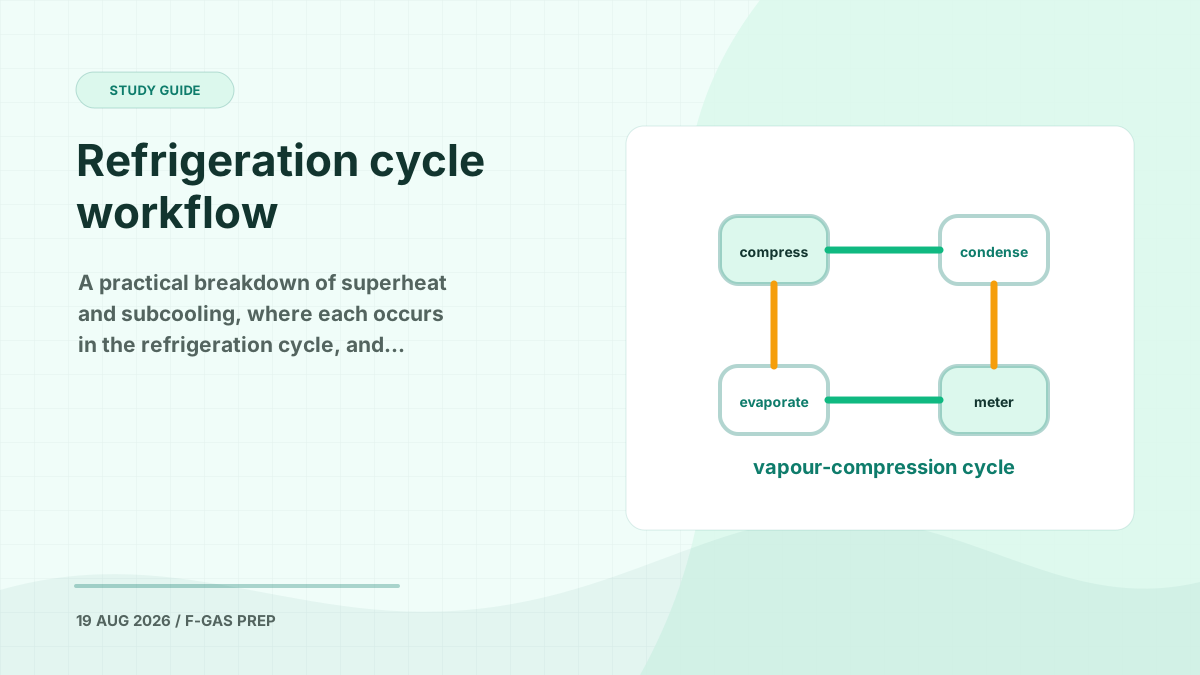
Ask ten technicians to define superheat and subcooling and you will get ten slightly different answers, most of them tangled up in enthalpy diagrams. For the City & Guilds 2079 assessment — and for daily fault finding — you can strip both concepts down to a single sentence each. That simplification is exactly what this walkthrough from AC Service Tech delivers, and it is worth committing to memory before you sit your F-Gas exam.
Walk the Cycle First
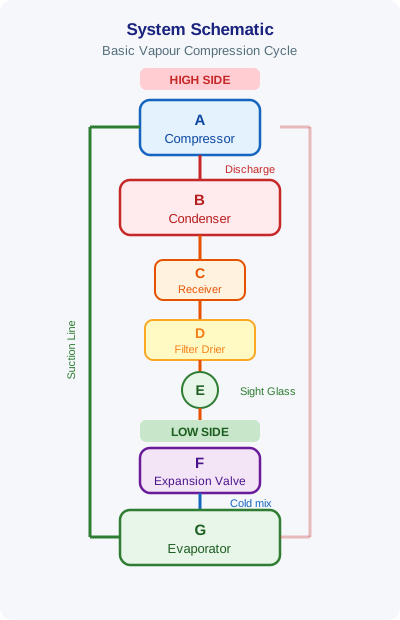
Before either term makes sense, you have to be able to trace the refrigerant round the circuit and say what state it is in at every point. The video runs it in one breath:
“You have a low pressure low temperature vapour coming into the compressor and then high pressure high temperature vapour coming out at its hottest point.”
From there:
- Compressor discharge — high pressure, high temperature vapour at its hottest point in the entire system.
- Condenser — the vapour rejects heat until it reaches a saturated state where vapour and liquid coexist. It continues rejecting heat until it is fully liquid, then keeps dropping in temperature as a liquid. That final temperature drop is subcooling.
- Liquid line and filter drier — the drier absorbs any moisture left in the system, protecting the metering device from acid formation and ice blockage.
- Metering device — a sharp pressure drop turns high pressure, high temperature liquid into low pressure, low temperature refrigerant that is roughly 80% liquid and 20% flash gas.
- Evaporator — the mixture absorbs heat, passes through the saturated state in the middle of the coil, and becomes complete vapour. Any further temperature rise after that point is superheat.
- Suction line — low pressure, low temperature vapour returns to the compressor and the cycle repeats.
That sequence is the backbone of City & Guilds 2079 Skill Group 1 (basic thermodynamics and the refrigeration cycle), and it underpins the leak-checking and charging questions in the practical assessment too.
Superheat in One Sentence
“Superheat is the temperature increase in vapour form in the evaporator coil.”
That is the whole definition. The reason it works so well as a memory hook is that there is only one place in the evaporator where pure vapour exists — after the saturated section, near the outlet. So if you are talking about vapour in the evaporator, you are talking about superheat.
To measure it you need two readings:
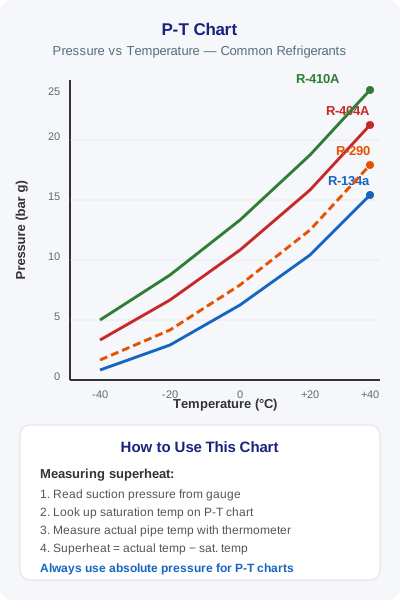
- Suction pressure, converted to saturation temperature using a pressure–temperature chart or an app for the specific refrigerant.
- Line temperature at the same point, taken with a well-clamped and insulated probe.
Superheat = measured line temperature − saturation temperature.
In practice, as the video notes, we rarely get a port right at the evaporator outlet, so we take the readings at the suction service valve by the compressor. That gives total superheat — evaporator superheat plus whatever heat the suction line picks up on the way back. It is the figure most manufacturer charging charts are built around.
Subcooling in One Sentence
“Subcooling is the temperature decrease in liquid form in the condenser coil.”
Same logic in mirror image. There is only one place in the condenser where pure liquid exists — after the saturated section — so liquid in the condenser means subcooling. Measure it at the liquid line service valve, because that is where you can get an accurate pressure reading alongside a clean temperature reading.
Subcooling = saturation temperature (from liquid line pressure) − measured liquid line temperature.
Why does it matter so much? Because the metering device is designed to receive a solid column of liquid:
“You need subcooling to make sure that when the liquid finally gets over to the metering device it has complete liquid and there’s no vapour present. If there is vapour present it’s not going to be very efficient.”
Vapour bubbles arriving at an expansion valve or capillary tube reduce mass flow and starve the evaporator. The system loses capacity, the suction pressure drops, and you can easily misdiagnose it as an undercharge when the real problem is insufficient subcooling from a restricted liquid line or a partially blocked drier. Subcooling also confirms you have enough refrigerant volume stacked in the condenser to feed the valve steadily.
Note the neat asymmetry the video points out: subcooling values are usually printed on the unit’s rating plate, whereas target superheat is not — you have to look it up for the conditions on the day.
Superheat Protects the Compressor
This is the point examiners keep coming back to. Refrigerant liquid is effectively incompressible. If liquid reaches the compressor you risk slugging, valve plate damage, washed-out bearings and, on hermetic units, a burnout that ends up as an F-Gas recovery job.
“If you have superheat you know you’re going to have vapour going into the compressor. If your superheat is zero, then, or even one or two, by the time it gets to the compressor there potentially could be some liquid getting into the compressor.”
A measured superheat of zero does not mean “just barely dry” — it means the refrigerant is still in the saturated region at that point, so there could be liquid mixed in with the vapour and you simply cannot tell how much. A safe margin of superheat is your only guarantee.
TEV Systems vs Fixed Orifice Systems
How you charge depends entirely on the metering device fitted:
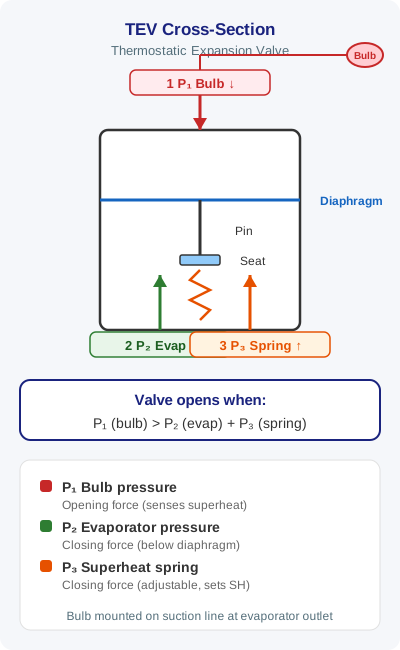
Thermostatic expansion valve (TEV/TXV)
- The valve modulates to hold superheat at its setpoint on its own, provided the charge is correct.
- Because superheat is held constant by the valve, it is useless as a charging indicator — so you charge by subcooling, using the value on the rating plate.
- Measure at the liquid line service valve on the outdoor unit.
Piston, fixed orifice or capillary tube
- There is no modulation, so superheat floats with load and ambient conditions.
- You charge by superheat, measured at the suction service valve.
“In the case of a thermostatic expansion valve, the thermostatic expansion valve is actually going to be controlling the superheat, but in the instance of a piston or an orifice or a capillary tube you need to check the refrigerant charge in superheat.”
Target Superheat Changes With the Weather
The single most common charging error on fixed-orifice systems is using a fixed number. Target superheat is not a constant — it is read from a charging chart using outdoor dry bulb temperature and indoor wet bulb temperature for the conditions on the day.
- Hot outside and humid inside → high evaporator load → high target superheat.
- Cool outside, cool and dry inside → low evaporator load → low target superheat.
If you charge a system to a high superheat figure on a hot, humid afternoon and then that same system runs on a cool, dry morning, superheat can collapse and liquid can find its way back to the compressor. The video is blunt about the consequences:
“You have to set it to the outdoor temperature and the wet bulb for that day on the target superheat chart… so that on a cooler day you don’t have liquid getting into the compressor. It’s a big deal.”
The second reason is efficiency. Excessive superheat means part of the evaporator is doing nothing useful, capacity falls and the compressor runs hotter than it should.
Why This Matters for F-Gas Compliance
Superheat and subcooling are not just performance figures — they feed directly into obligations under EU Regulation 517/2014:
- Article 3 requires operators to prevent leakage and to repair detected leaks without undue delay. A system running with wildly abnormal superheat or subcooling is often telling you about a leak, a restriction or a charge error that needs investigating before it becomes an emission.
- Article 4 sets leak-checking frequencies based on CO₂-equivalent charge (5 tonnes, 50 tonnes, 500 tonnes CO₂e thresholds, with intervals halved where no leak detection system is fitted).
- Article 8 requires refrigerant recovery by certified personnel. Overcharging to “fix” a poor superheat reading simply loads the system with gas that eventually has to be recovered — or leaks.
- Article 10 and Annex I of Regulation 2015/2067 define the certification categories. Category I holders may carry out all leak checking, recovery, installation, maintenance and repair activity; charging and performance checks such as these sit squarely within that competence.
On the City & Guilds 2079 side, expect superheat and subcooling questions to surface across the thermodynamics and refrigeration cycle skill group, the system commissioning and charging content, and the fault-finding sections of the practical assessment. Being able to state both definitions cleanly, name the measurement point for each, and explain which one you charge by is a reliable few marks.
Exam tip: If a question mentions a TEV, think subcooling. If it mentions a capillary tube, orifice or piston, think superheat. That single mapping resolves a surprising number of multiple-choice questions.
Quick Revision Summary
| Superheat | Subcooling | |
|---|---|---|
| Refrigerant state | Vapour | Liquid |
| Component | Evaporator | Condenser |
| Occurs | After the saturated section | After the saturated section |
| Measured at | Suction service valve (total superheat) | Liquid line service valve |
| Protects | Compressor from liquid return | Metering device from flash gas |
| Charge by it when | Fixed orifice, piston, capillary tube | Thermostatic expansion valve |
| Target value from | Charging chart (outdoor DB + indoor WB) | Unit rating plate |
How F-Gas Exam Prep Fits Into This
Definitions like these are exactly the sort of thing that feels obvious on the van and evaporates under exam pressure. The F-Gas Exam Prep app is built to close that gap:
- 370+ exam questions across all skill groups, including a dedicated bank on thermodynamics and the refrigeration cycle where superheat, subcooling, saturation and pressure–temperature relationships come up repeatedly.
- Mock exams that mirror the real City & Guilds 2079 format, so you practise under the same timing and question structure you will face on assessment day.
- AI voice challenges for interactive revision — say your answer out loud, the way you would explain it to an assessor, and get instant feedback. Ideal for drilling “superheat is the temperature increase in vapour form in the evaporator” until it is automatic.
- Detailed explanations for every answer, so when you get a subcooling question wrong you learn why the TEV changes the charging method rather than just memorising the correct option.
Work through the thermodynamics topic, then run a full mock. If superheat and subcooling questions still trip you up, the explanations will point you straight back to the part of the cycle you need to revisit.
Start Practising Today
Download the F-Gas Exam Prep app and study with 460+ practice questions, mock exams, and detailed explanations.