Superheat and Subcooling Explained: The Two Measurements Every F-Gas Engineer Must Master
A practical guide to superheat and subcooling for City & Guilds 2079 candidates, covering the theory, the formulas and why both protect the system.
Ask a room of refrigeration engineers what superheat is and you will get a surprising range of answers. Some will reel off the formula perfectly. Others will look at their boots. As the video puts it:
“Most people in the HVAC industry are not familiar with superheat and subcooling. But it is important to be aware of this.”
That is a generous way of saying it. Superheat and subcooling are not optional extras — they are the two numbers that tell you whether a system is charged correctly, whether the expansion device is doing its job, and whether the compressor is about to be destroyed. For anyone preparing for City & Guilds 2079, they sit squarely in the thermodynamics and refrigeration principles content, and they turn up again in the practical assessment when you are asked to take and interpret system readings.
Let us build the concept from the ground up, exactly as the video does — with a kettle of water.
Start With Water, Not Refrigerant
Heat a pan of water at atmospheric pressure and the temperature climbs steadily: 20 °C, 50 °C, 80 °C. At 100 °C it stops climbing. All the energy you continue to add now goes into changing the state of the water from liquid to vapour rather than raising its temperature. That is latent heat, and while it is happening the water sits stubbornly at its boiling point.
Keep heating after every drop has boiled away and the temperature starts rising again. That vapour is now superheated.
“Heating of water above its boiling point is the superheat.”
The formula is refreshingly simple:
Superheat = current temperature − boiling (saturation) temperature
If the steam reads 107 °C and the boiling point is 100 °C, the superheat is 7 K.
Subcooling is the mirror image. Take vapour at 120 °C and cool it. At 100 °C it begins to condense back into liquid, and it will hold at 100 °C until the last of the vapour has turned to liquid. Cool it below that point and you have subcooling:
Subcooling = condensing (saturation) temperature − current temperature
Liquid at 90 °C with a condensing temperature of 100 °C gives 10 K of subcooling.
“Subcooling is the opposite process of Superheat. That is, Subcooling occurs in condensation process as Superheat occurs in evaporation process.”
The Word Everyone Forgets: Saturation
Here is where candidates lose marks. In the water example the boiling point is 100 °C because we assumed atmospheric pressure. Change the pressure and the boiling point changes with it — this is the single most important idea in refrigeration.
R134a does not have “a” boiling point. It has a boiling point for every pressure. At around 3.5 bar gauge it boils near 8 °C; at 0.6 bar gauge it boils near −15 °C. That is precisely why we can make a refrigerant boil at −10 °C inside a cold room evaporator and condense at +45 °C in a condenser sitting in the sun. We are not changing the refrigerant, only the pressure acting on it.
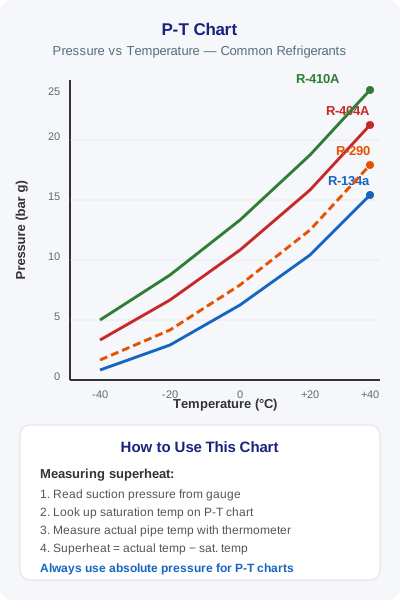
So on a real system you never measure saturation temperature directly. You measure pressure with a gauge and convert it to saturation temperature using a P–T chart or the scale printed on the gauge face. Then you measure the actual pipe temperature with a probe. The difference between the two is your superheat or subcooling.
- Superheat: suction pressure → saturation temperature; compare with measured suction line temperature at the evaporator outlet.
- Subcooling: discharge/high-side pressure → saturation temperature; compare with measured liquid line temperature at the condenser outlet.
Exam tip: Superheat and subcooling are temperature differences, so express them in kelvin (K), not degrees Celsius. A 7 K superheat is correct; “7 °C of superheat” is loose language that examiners and assessors will pick up on.
Why Superheat Protects the Compressor
Now put the theory into the circuit.
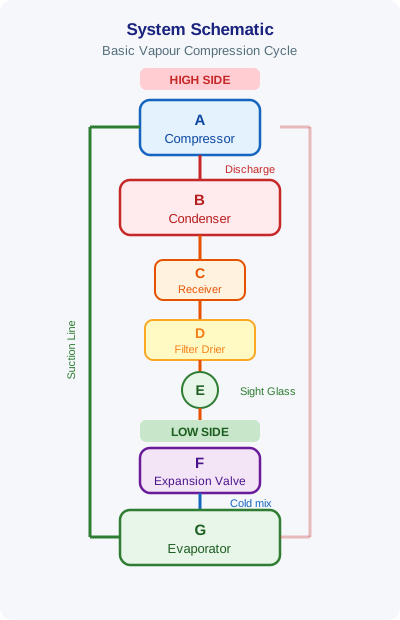
The compressor exists to raise the pressure of refrigerant vapour. That is all it can do.
“We can only compress Vapor. We cannot compress liquid. Liquid is an incompressible thing.”
If liquid refrigerant makes it back down the suction line and into the cylinder, the piston attempts to compress a fluid that simply will not reduce in volume. The result is hydraulic shock — commonly called liquid slugging — and it breaks valve plates, bends connecting rods and wrecks discharge valves. It is one of the fastest ways to turn a service call into a compressor replacement.
Superheat is the safety margin that prevents this. If the refrigerant leaving the evaporator is 6 K above its saturation temperature, you know with certainty that every last droplet has boiled off, because liquid and vapour cannot coexist above the saturation point. The superheat reading is your proof that only vapour is heading for the compressor.
The trade-off matters too:
- Too little superheat (or none at all) — liquid floodback, oil dilution, slugging risk, and a compressor that will not last.
- Too much superheat — the evaporator is being starved, so a large part of the coil surface is doing nothing useful. Capacity drops, efficiency falls, and discharge temperatures climb high enough to break down the oil.
A well set up direct expansion system typically runs somewhere around 5–8 K of superheat at the evaporator outlet, controlled by a thermostatic or electronic expansion valve modulating refrigerant feed.
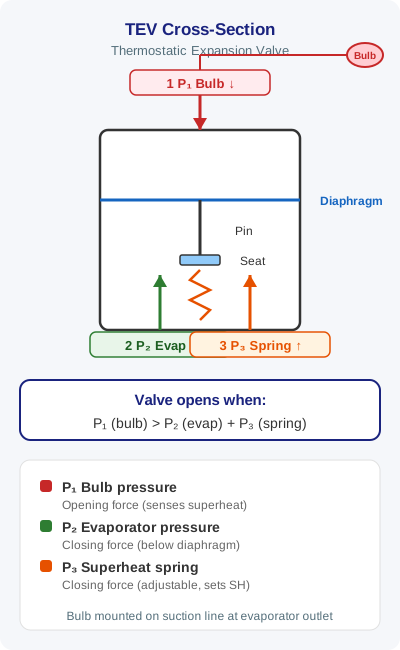
The TEV sensing bulb strapped to the suction line is doing exactly the measurement described above, mechanically and continuously — bulb pressure pushes the valve open, evaporator pressure and the superheat spring push it closed. The valve settles wherever those forces balance, which is at its set superheat.
Why Subcooling Protects the Expansion Device
At the other end of the circuit, the requirement is the exact opposite.
“Refrigerant should go only in liquid state while going to expansion valve. Only then we can get well cooled air from evaporator.”
The expansion valve is sized and rated to meter liquid. If vapour bubbles arrive with the liquid — a condition known as flash gas — the valve passes a mixture of far lower density, so the mass flow of refrigerant into the evaporator collapses. The coil is starved, capacity drops away and, awkwardly for diagnosis, superheat rises at the same time.
Subcooling is what guarantees a solid column of liquid. Cool the liquid a few kelvin below its condensing temperature and it has margin in hand: it can pick up a little heat through the liquid line, or lose a little pressure through a filter drier and a long vertical rise, without flashing to vapour.
Subcooling is also one of the most reliable charge indicators on a system with a TEV. Broadly:
| Subcooling reading | Usual interpretation |
|---|---|
| Very low or zero | Undercharge, or restriction upstream of the measurement point |
| Normal (typically ~4–8 K) | Correct charge and a clear liquid line |
| High | Overcharge, or condenser problem — dirty coil, failed fan, non-condensables |
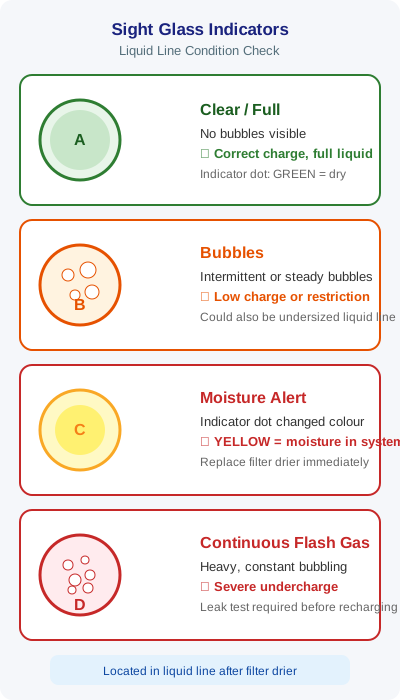
The sight glass is the quick visual version of the same story — bubbles usually mean you have run out of subcooling — but a numerical subcooling reading tells you how much margin you have, which the sight glass never can.
Reading the Two Numbers Together
Neither figure means much in isolation. Diagnosis comes from the pair:
- Low superheat, high subcooling — overcharged, or the expansion valve is overfeeding.
- High superheat, low subcooling — undercharged, or a restriction is starving the evaporator.
- High superheat, high subcooling — a restriction between condenser and evaporator: blocked filter drier, kinked liquid line, or a valve that has failed closed.
- Low superheat, low subcooling — an overfeeding valve, or a compressor that is not pumping properly.
This is exactly the reasoning City & Guilds 2079 practical assessments are built around. You are not simply asked to recite a formula; you are asked to connect gauges to a live system, take readings safely, and say what the numbers mean.
The F-Gas Connection
It is fair to ask what any of this has to do with EU Regulation 517/2014 and the retained GB F-Gas regime. The link is direct.
- Article 3 requires operators to take all precautionary measures to prevent unintentional release, and to repair leaks without undue delay. An engineer who charges by gauge pressure alone, with no reference to superheat or subcooling, is guessing — and guessing tends to end in an overcharge, a vented system, or a repeated top-up that masks a genuine leak.
- Article 4 sets the leak-checking regime by CO₂-equivalent charge, and Article 6 requires accurate records of quantities added and recovered. Charging correctly the first time keeps those records honest.
- Article 10 and Implementing Regulation (EU) 2015/2067 define the certification categories. Category I certification covers leak checking, recovery, installation, maintenance, servicing and decommissioning of all equipment sizes — and taking meaningful measurements is exactly the competence being certified.
Repeatedly topping up a system because “the sight glass was bubbling” without understanding subcooling is not just poor engineering. It is a route to unnecessary refrigerant loss, which is precisely what the Regulation exists to prevent.
Key point: Charging a system by superheat and subcooling rather than by feel is a leak-prevention measure as much as a performance one.
What to Take Into the Exam
The video ends with a compact list worth memorising:
- Superheat is the heating of a liquid beyond its boiling (saturation) point.
- Subcooling is the cooling of vapour beyond its condensing (saturation) point.
- Superheat takes place in the evaporator (and the suction line).
- Subcooling takes place in the condenser (and the liquid line).
- Refrigerant must enter the compressor as vapour only, because only vapour can be compressed.
- Refrigerant must enter the expansion device as liquid only, because the valve is rated for liquid.
Add to that the point the water analogy quietly hides: saturation temperature depends on pressure, so every superheat or subcooling calculation begins with a pressure reading converted through a P–T chart for the specific refrigerant in that system.
How F-Gas Exam Prep Fits Into This
Thermodynamics is where a lot of 2079 candidates come unstuck, because it rewards understanding rather than memorisation. The F-Gas Exam Prep app is built for exactly that gap:
- 370+ exam questions spanning every skill group, including a substantial bank on thermodynamics, saturation, superheat and subcooling.
- Mock exams that mirror the real City & Guilds 2079 format, so the pressure of timing and question style is familiar before you sit the paper.
- AI voice challenges for interactive revision — genuinely useful for this topic, because being asked out loud “the system reads high superheat and low subcooling, what is your diagnosis?” is much closer to how an assessor will question you than a multiple-choice list.
- Detailed explanations for every answer, so when you get a P–T conversion wrong you learn why, rather than just seeing a red cross.
Work through the thermodynamics and refrigeration principles questions until converting a gauge pressure to a saturation temperature and calculating the difference feels automatic. On assessment day, that fluency is the difference between hesitating over the gauges and reading a system with confidence.
Start Practising Today
Download the F-Gas Exam Prep app and study with 460+ practice questions, mock exams, and detailed explanations.