What Is Refrigerant? How It Works in the Refrigeration Cycle
Refrigerant is the working fluid that transfers heat in fridges, air conditioners and heat pumps. See how it changes between liquid and vapour.
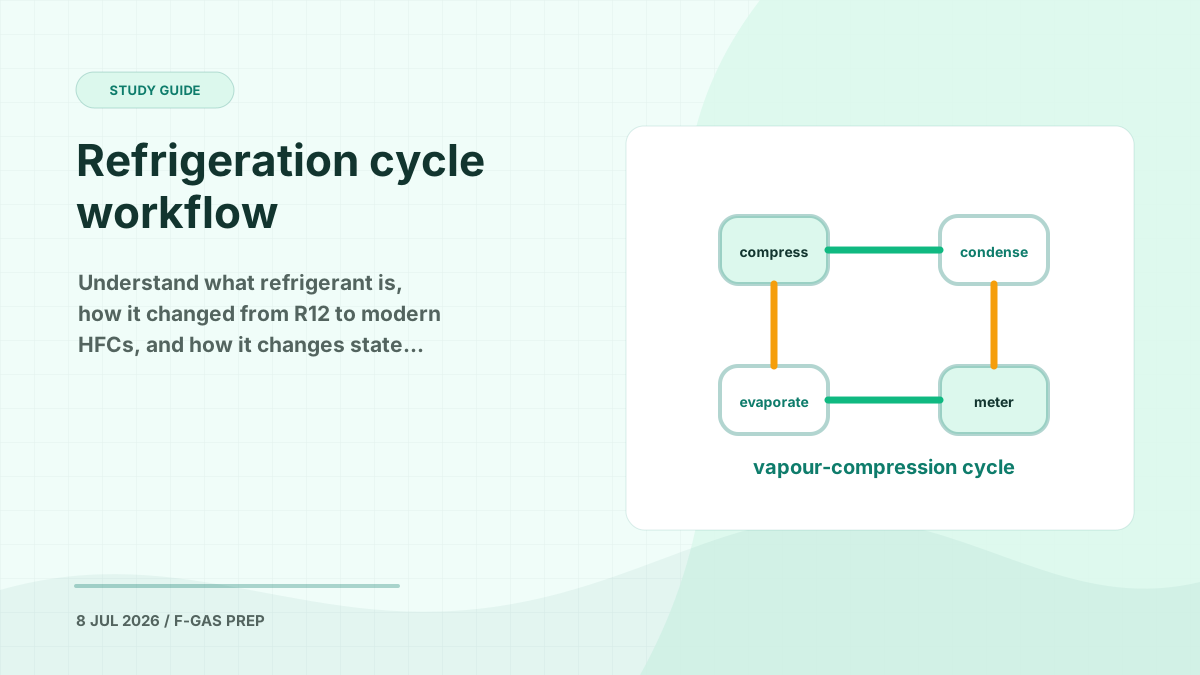
Refrigerant is the working fluid in a refrigerator, air conditioner, heat pump or chiller. It absorbs heat in one part of the system and releases it in another, repeatedly changing between liquid and vapour as pressure and temperature change.
Calling it “refrigerant gas” tells only half the story. Inside a working vapour-compression system, refrigerant can be a liquid, a vapour, or a mixture of both. This guide explains each state, the main refrigerant families and the properties F-Gas candidates need to understand.
What Refrigerant Actually Is
A refrigerant is a substance used in cooling devices — air conditioners, refrigerators, heat pumps and chillers — to move heat from where it is not wanted to where it can be safely rejected. Crucially, it does not stay in one physical state. Depending on the temperature and pressure it is subjected to, the same refrigerant exists as a liquid at one point in the circuit and a vapour at another.
This ability to boil and condense at convenient temperatures is what makes cooling possible. When a liquid boils, it absorbs a large amount of heat (its latent heat of vaporisation) without getting hotter itself. That is the trick every refrigeration system exploits.
Is Refrigerant a Gas or a Liquid?
It is both, depending on where it is in the cycle. Refrigerant is mainly vapour at the compressor inlet and outlet, liquid after condensing, and a liquid-vapour mixture after the expansion device and through much of the evaporator.
Technicians use the word vapour rather than gas when the substance can condense back to liquid at the operating temperature and pressure. The changing state matters because boiling absorbs latent heat and condensing releases it.
Types of Refrigerant
| Family | Examples | Main point |
|---|---|---|
| CFC | R12 | High ozone-depletion impact; phased out |
| HCFC | R22 | Lower ozone impact than CFCs but still ozone-depleting; phased out for new use |
| HFC | R134a, R32, R410A | No ozone-depletion potential, but many have significant global warming potential |
| HFO and HFO blends | R1234yf, R454B | Lower-GWP alternatives, with system-specific safety and compatibility requirements |
| Natural refrigerants | R290, R600a, R744, R717 | Very low GWP options with flammability, pressure or toxicity considerations |
The correct refrigerant is the one the equipment was designed, labelled and approved to use. Never mix refrigerants or retrofit a system without following the manufacturer’s instructions and applicable safety rules.
A Short History: From Early Refrigerants to Lower-GWP Alternatives
The refrigerants we use today are the result of a century of trial, error and hard lessons.
- Early days — dangerous chemicals. The first refrigerants included ammonia, sulphur dioxide and methyl chloride. They worked, but a leak was genuinely hazardous to anyone nearby and could even prove fatal.
- 1928 — the first “safe” refrigerant. R12, a chlorofluorocarbon (CFC), was introduced as a non-flammable, low-toxicity alternative. For decades it seemed like the perfect solution.
- 1980s — the ozone problem. It became clear that the chlorine in CFCs was severely damaging the ozone layer. As the video puts it:
“When 1 kg of R12 refrigerant leaks it causes the same damage as 10 tons of carbon dioxide.”
- The phase-out. The manufacture, buying and selling of R12 was banned. It is no longer produced anywhere.
- HFC adoption. Refrigerants such as R134a and R410A became widely used because they do not deplete the ozone layer, although many have a high global warming potential.
- Lower-GWP transition. Newer systems increasingly use HFO blends, R32 and natural refrigerants. The choice brings different flammability, pressure, toxicity and equipment-compatibility considerations.
This history is why F-Gas law controls fluorinated greenhouse gases. Although HFCs solved the ozone problem, many still have a significant global warming potential (GWP). Great Britain retains F-Gas rules on HFC phase-down, leak checks based on CO₂-equivalent tonnage, recovery and technician qualifications. Understanding the ozone-layer-versus-climate distinction — the Montreal Protocol tackled ozone depletion, while F-Gas law tackles climate impact — is a favourite exam theme. See the current UK F-Gas guidance for compliance information.
The Properties of a Good Refrigerant
No single fluid is perfect, but the ideal refrigerant would tick every one of these boxes. Expect to be tested on them:
- Low boiling point — so it can evaporate at the low temperatures needed for cooling.
- High critical temperature — so it can still be condensed with ambient air or water.
- High latent heat — more heat absorbed per kilogram circulated means a smaller, more efficient system.
- High thermal conductivity — for efficient heat transfer through the coils.
- Non-corrosive — it must not attack the materials, seals and oils in the system.
- Non-flammable and non-explosive — for safe handling and installation.
- Non-toxic — safe for occupants and technicians.
- Cheap and readily available.
- Low ozone and environmental impact — the modern, F-Gas-driven priority.
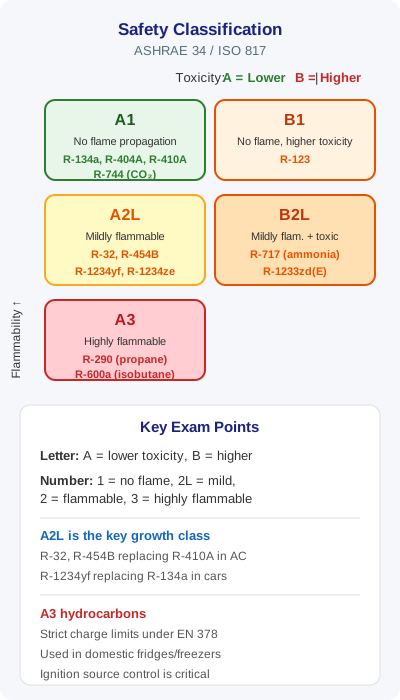
Notice how several of these properties pull against each other. Low-GWP alternatives such as R32 and the hydrocarbons are more flammable, which is why the A1 / A2L / A3 safety classifications matter so much on site. This trade-off between environmental performance and flammability is central to both modern system design and the safe-handling section of your 2079 training.
How Refrigerant Moves Round the Cycle
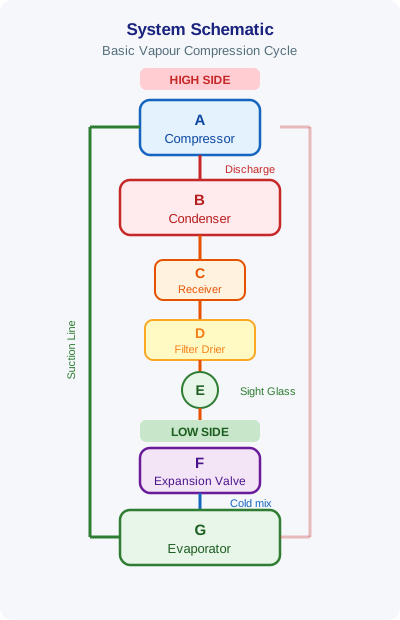
Here is where states and pressures come together. A refrigerant’s saturation temperature changes with pressure, allowing it to boil at a low temperature in the evaporator and condense at a higher temperature in the condenser.
1. Evaporator (indoor unit). A cold, low-pressure liquid-vapour mixture enters the coil. Air or another fluid passes across the evaporator, and the transferred heat boils the remaining liquid refrigerant. It leaves as a low-pressure vapour, normally with controlled superheat.
2. Compressor (outdoor unit). The compressor draws in that low-pressure vapour and squeezes it. This raises the pressure dramatically, which is the only way the fluid can be pushed around the rest of the circuit and later condensed. It leaves as a high-pressure, high-temperature vapour.
3. Condenser (outdoor coil). The hot vapour flows through the outdoor coil while a fan blows ambient air across it. The refrigerant rejects its heat to the outside air, its temperature falls, and it condenses back into a liquid. It leaves as a high-pressure, liquid refrigerant.
4. Expansion device. Finally the high-pressure liquid passes through the metering device, where its pressure and saturation temperature drop sharply. Some liquid flashes into vapour, so the refrigerant leaves as a cold, low-pressure liquid-vapour mixture ready to enter the evaporator.
If you can recite those four state changes — and, just as importantly, the pressure and temperature at each point — you have the backbone of the refrigeration-cycle questions that appear throughout the exam. A useful memory hook: the compressor and expansion valve change the pressure, while the evaporator and condenser change the state.
Why This Matters for Certified Technicians
Under F-Gas, understanding these states is not academic. Recovering refrigerant correctly, brazing without contaminating the charge, diagnosing a low charge from gauge readings and calculating a system’s CO₂-equivalent charge all rest on knowing where the fluid is liquid, where it is vapour, and at what pressure. That knowledge is what separates a competent, certified engineer from someone who simply tops up gas and hopes for the best — and it is exactly what the assessment is designed to confirm.
Use the free refrigerant GWP and CO₂-equivalent calculators to practise turning a charge in kilograms into tonnes CO₂e, or review the refrigeration-cycle study topic before trying the related questions.
How F-Gas Exam Prep Fits Into This
The refrigeration cycle, refrigerant properties and the CFC-to-HFC history all sit squarely within the City & Guilds 2079 syllabus, and they are areas where candidates lose easy marks simply through fuzzy recall. The F-Gas Exam Prep app is built to fix exactly that:
- 460+ exam questions spanning every skill group, including refrigerant properties, environmental legislation and the practical cycle, so you drill the state-change and pressure questions until they are second nature.
- Mock exams that mirror the real City & Guilds 2079 format, so exam day feels familiar rather than daunting.
- AI voice challenges that let you talk through the cycle out loud — perfect for cementing the “low-pressure vapour into the compressor, high-pressure liquid out of the condenser” sequence.
- Detailed explanations for every answer, so when you get a question on why R12 was banned or which property matters most, you learn the reasoning and not just the correct option.
Master what refrigerant is and how it behaves around the circuit, and a whole cluster of exam questions becomes straightforward. Put in the practice now, and you will walk into your 2079 assessment ready to explain the cycle as confidently as you can feel the cold air coming off the evaporator.
Start Practising Today
Download the F-Gas Exam Prep app and study with 460+ practice questions, mock exams, and detailed explanations.